
We flew from Pakistan into the northeastern city of Mashhad in Iran. The two countries have a land border in Balochistan, but it’s dodgy. You need a special permit and an armed guard. We’re not quite reckless enough yet to go somewhere that requires a military escort, hence the plane.
At first, I thought Iran was going to be like it’s portrayed in the Western media. There was a big sign at the airport saying it’s the law to wear the hijab. Okey-doke, I thought, I can do that. I’ve had some practice now. Then, every woman I saw on the street was wearing a black chador – the voluminous cape covering their head and whole body, apart from their face or sometimes their eyes (niqab). It seems, though, that this was because we were staying in the area around the Holy Shrine. In some of the city’s more modern and affluent areas, women were wearing regular clothes (albeit long-sleeved and ankle-length) with just a headscarf (hijab) or occasionally no head covering at all.
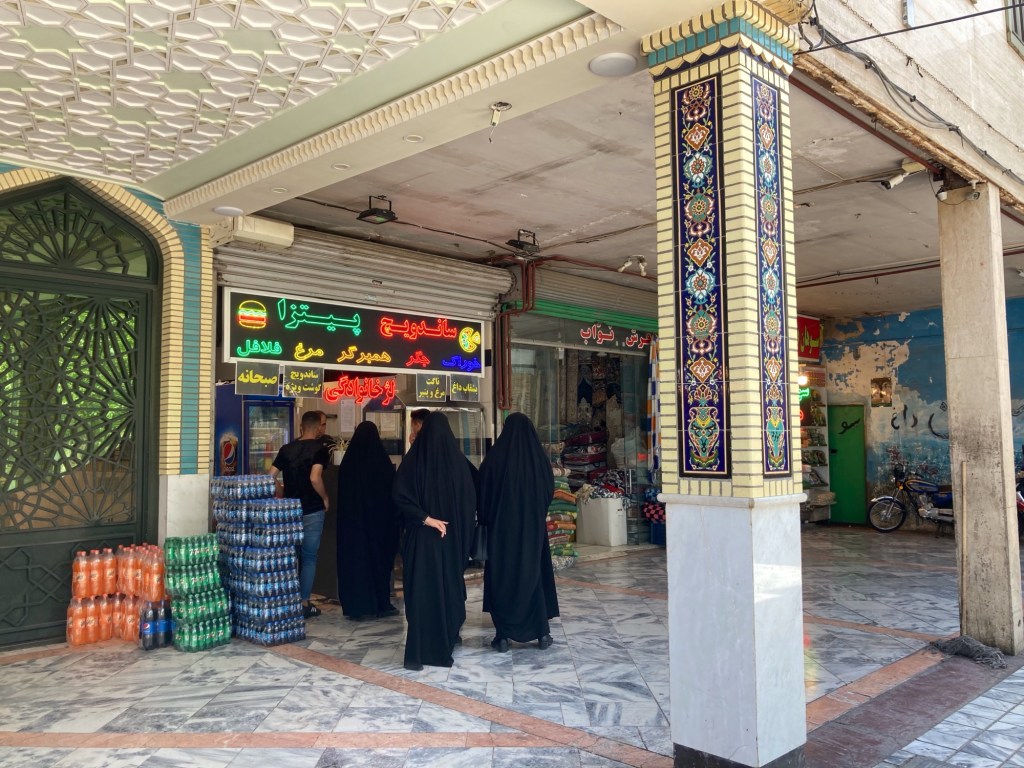
Iran is nothing like I feared and even better than I hoped. It can be logistically challenging due to international financial sanctions (foreign bank cards and services don’t work at all) and government censorship that blocks almost the entire internet, including all social media, booking sites and Google services. VPNs are hit-and-miss, and hotel Wi-Fi rarely works. Thankfully, I’d pre-booked a hotel and an airport transfer. Mohsen, the driver who picked us up, turned out to be our fairy godmother. He messaged me the next day to see if we were OK because we were obviously wide-eyed and clueless. He and his lovely wife, El, helped us navigate our first couple of weeks and gave us a crash course in Iranian culture.
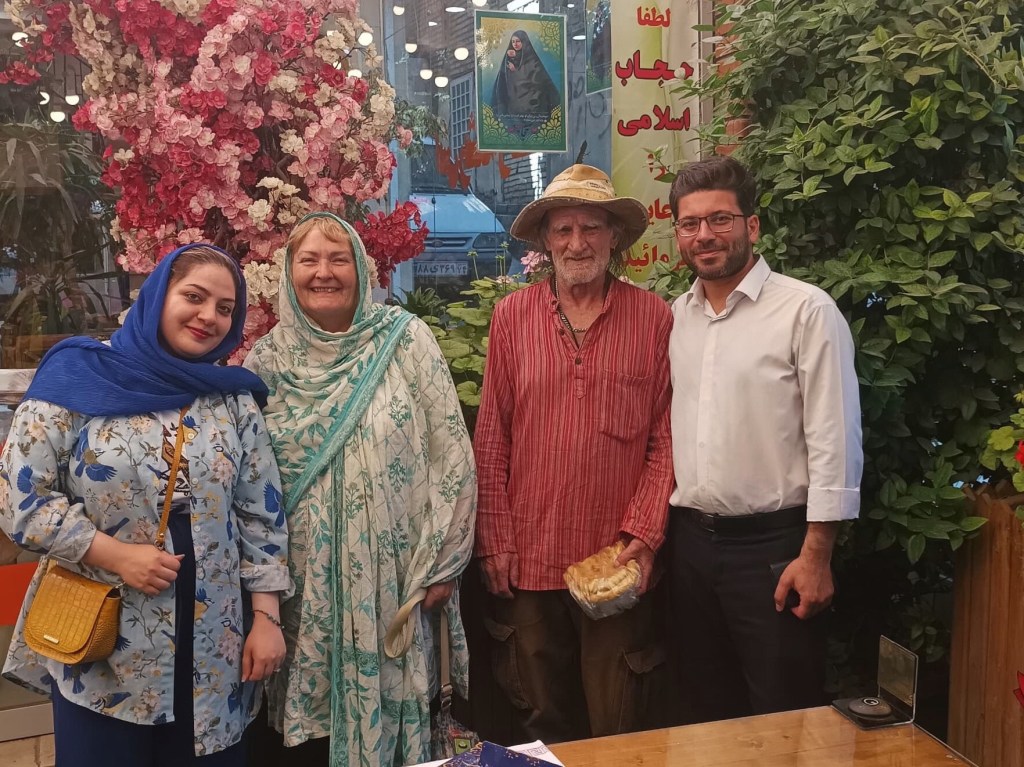
Mashhad was a village on the old Silk Road, but like everywhere in Iran, its beginnings go back thousands of years. Now, it is a beautiful, clean, modern city of around three and a half million people. It’s Iran’s second largest and most spiritual city, containing the Imam Reza Shrine (the Holy Shrine) with the tomb of the eighth Imam of Shia Islam. It’s the largest mosque complex in the world (by area) and has about 25 million annual visitors. It is both fascinating and impressive, but it was deathly hot the day we visited, and it was my first experience of having to wear a chador to gain entry. They are hot and uncomfortable, and I felt like I was in an episode of The Handmaid’s Tale.
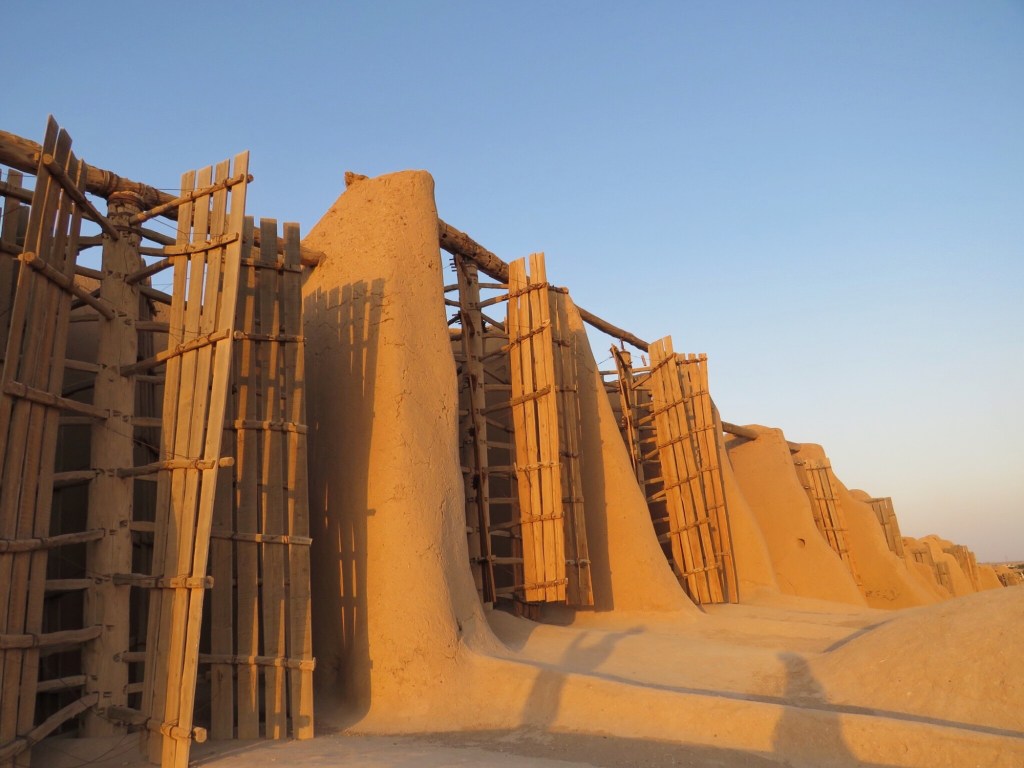
It’s been JH’s dream for years to see the ancient windmills of Nashtifan. The village is way off the beaten track, and it’s a full day’s drive out into the desert from Mashhad. These windmills, made of mud and wood, have been grinding flour for at least a thousand years. They are beautiful. JH actually got to meet the main man, the last remaining keeper of the windmills, but I missed it because I’d been waylaid by the embroidery ladies.
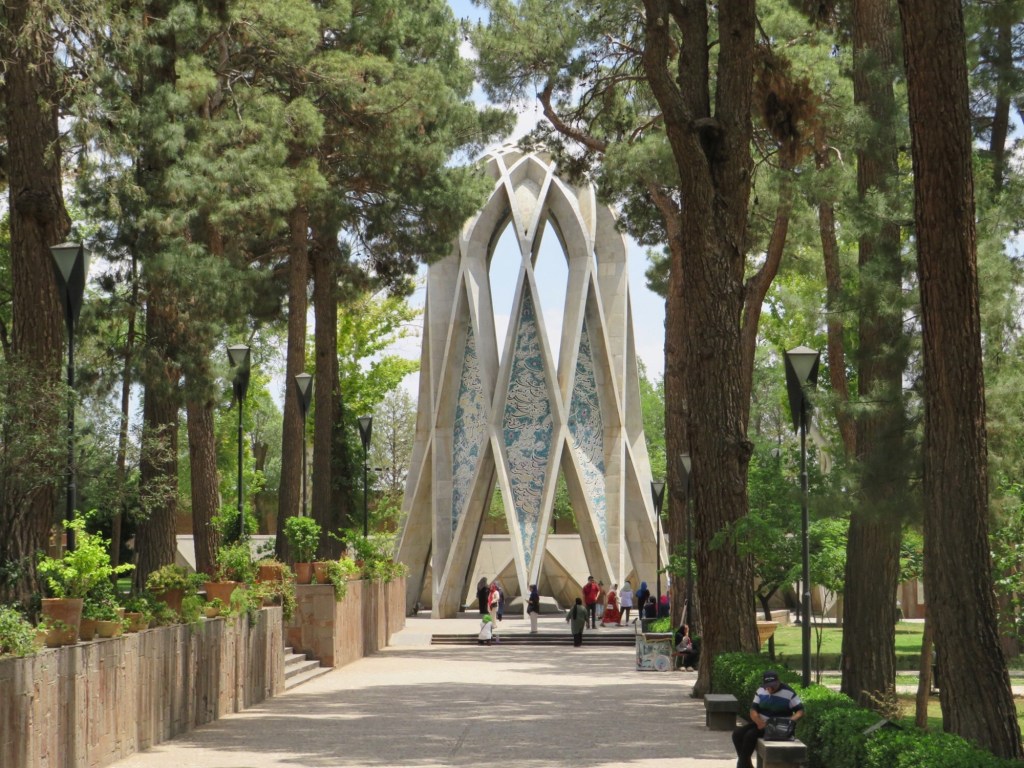
I was given a lovely copy of the Rubaiyat of Omar Khayyam many years ago. Omar Khayyam was a 12th-century mathematician, astronomer and poet. When I realised his tomb was in the nearby town of Neyshabur, I felt I had to visit. Also here is the tomb of another famous 12th-century poet, Attar of Neyshabur or Farid ud-Din. I hadn’t heard of him before, but he was a mystical Sufi poet and a big influence on the poet Rumi. His most well-known poem is The Conference of the Birds. It’s believed that laying your hands on his tomb imparts his cosmic energy. Astoundingly, I could feel the vibrations, and so could JH (a confirmed sceptic of anything cosmic). We had been trying to get train tickets to Kerman with no luck. Immediately after we exited Attar’s tomb, Mohsen got a phone call saying we had tickets on the overnight train. It seemed we’d received Attar’s blessing.
I loved everywhere in Iran but Kerman is one of those exotic desert frontier towns that are my favourite kind of places. Kerman was on the old Spice Road that existed long before the Silk Road. Around every corner is a new surprise – a hidden courtyard, a traditional Persian tea house, a fabulous mosque, a colourful bazaar, or a secret garden with bubbling fountains.
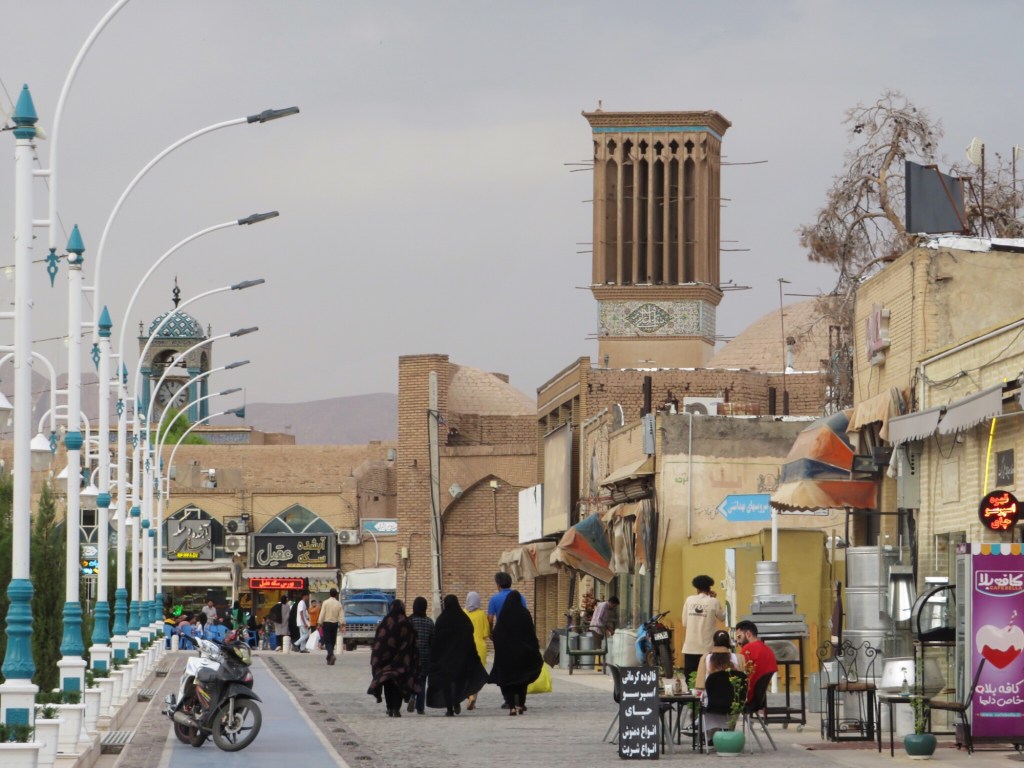
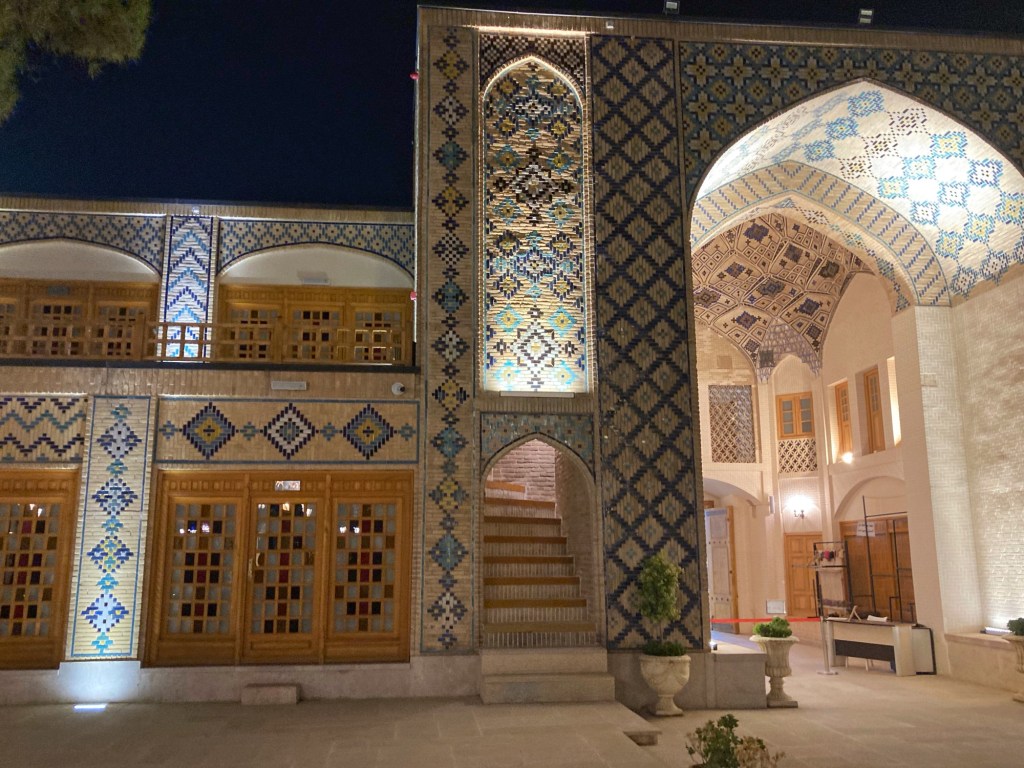
Staying in an old caravanserai (historical roadside inn) added to Kerman’s romance. I’ve never stayed in more consistently beautiful hotels anywhere else in the world. Iran is incredibly cheap for tourists, and you can have five-star luxury and hospitality for the same price as a shoebox in Western countries. The ‘traditional’ hotels we stayed in everywhere are all converted from old buildings that were once mansions, fancy houses, or caravanserais. Each one is unique.
Iran is a desert country. Not just a bit dry and scrubby but proper hardcore sandy desert. For thousands of years, every aspect of Persian culture and ingenuity has been centred around living comfortably in this harsh climate. Approximately 3000 years ago, they developed a sophisticated system of ‘qanats’ to transport water from a source, such as an aquifer, that’s gravity-fed via underground tunnels to where they needed it. These are all over the place and still functioning perfectly.
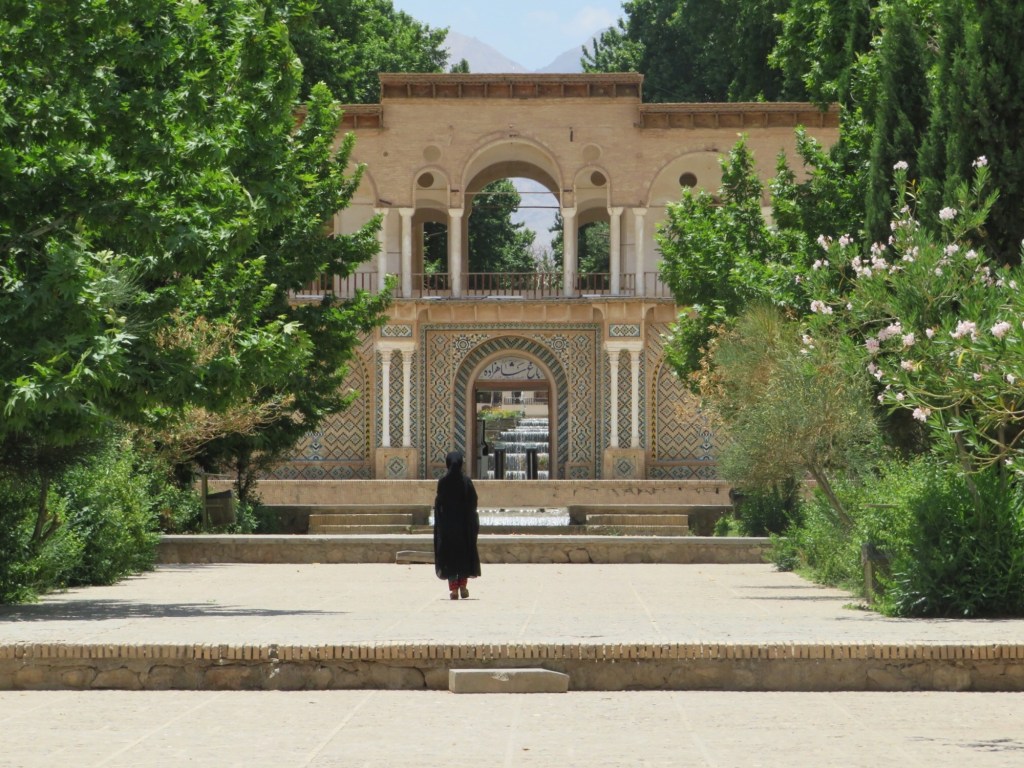
We saw a lot of Persian gardens in Iran, and they were all lovely. They all have a structured and symbolic landscape design that features shade and water. Interestingly, their design is echoed in traditional Persian carpets. It’s easy to see why they were so important in this climate, providing a cool, shady oasis in the desert – a paradise. The first one we saw was Shazdeh Garden in Mahan, and it’s still my favourite. I loved that it was so obviously an oasis surrounded by desert and it was clear to see how the water flowed from the Qanat, through the royal garden, then down to the village.
The Lut Desert between Kerman and the Afghanistan border is the hottest place on earth. The highest temperature recorded is 80.8 degrees Celsius. I did question what kind of crazy people would go there in summer. Only mad dogs and Englishmen, I suppose. And me. We waited in the oasis town of Shahdad on the edge of the desert until late afternoon so we wouldn’t get too fried. Shahdad was a flourishing city in the Bronze Age, around 5000 years ago. Its heydey lasted for 500 years.

Shahdad is now an intensely hot and dusty small town that grows dates. They do have a beautiful old water cistern, though. Water storage is another part of the water cycle where the ancient Persians showed such ingenuity. The domed shape of the roof reduces the surface area exposed to the sun, and the wind towers (badgirs) circulate the air. They used a small amount of salt to purify the water and filtered it through charcoal. There are taps with cold water for drinking on the streets all over Iran.
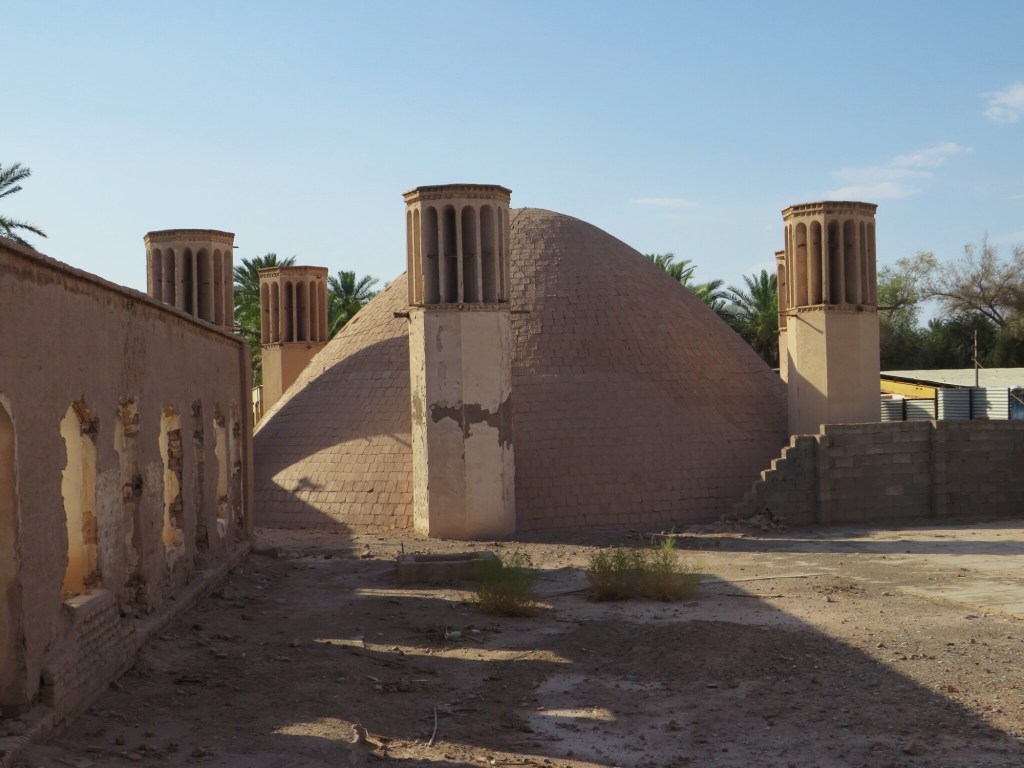
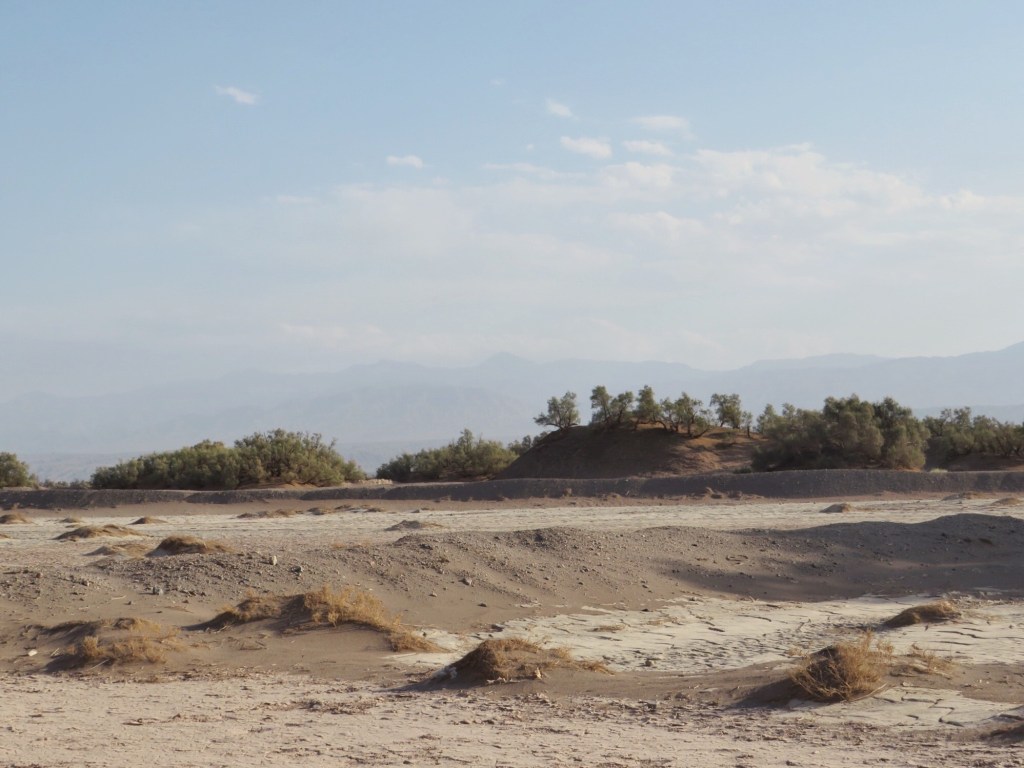
Settlements on the edge of the desert are partly protected from dust and sandstorms by a weird natural barrier called ‘Nabkhas’. When the wind blows the dunes, the sand collects around little scraps of vegetation that gradually build up to form sand pots. These pots can then nurture and grow Ghaz trees.
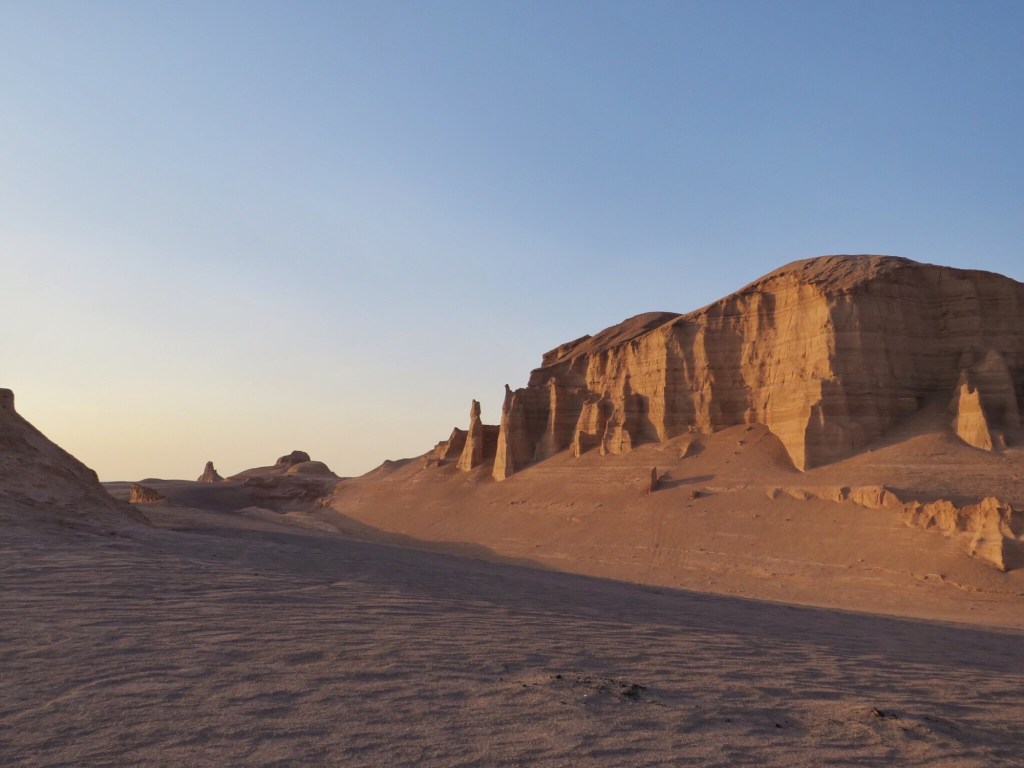
The main reason we were crazy enough to venture out in the heat was to see the Khaluts. In a landscape of nothing but sand dunes and salt deposits, the Khaluts are like a giant fantasy city rising out of the desert. The huge structures look like the ruins of castles and ancient civilisations but are geological structures formed naturally from sand, wind and rain.
Where there were no trains, we mostly hired a car with a driver to transfer between places. This is a relatively affordable option because petrol is so cheap. It costs about $4 to fill up the whole tank. The sanctions against Iran make cars insanely expensive, so most cars are old and full of dents. Traffic in Iran doesn’t seem to stick in designated lanes, so no wonder they keep bumping into each other.
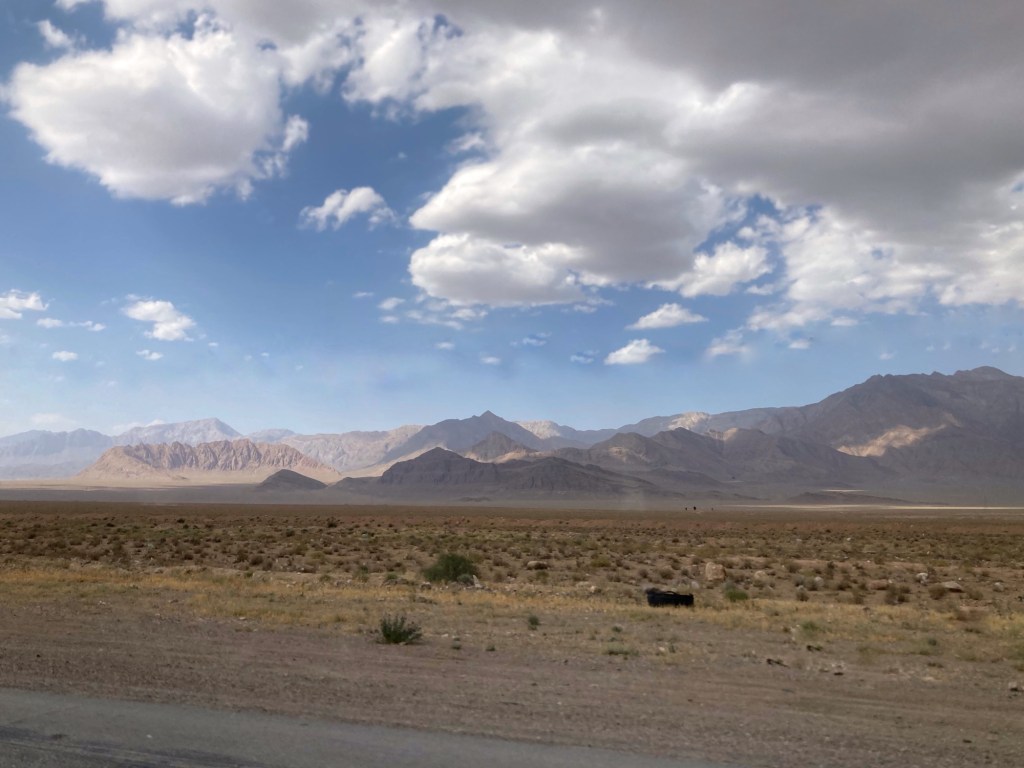
I was surprised that there are so many mountain ranges. You can usually see some in the distance wherever you go.
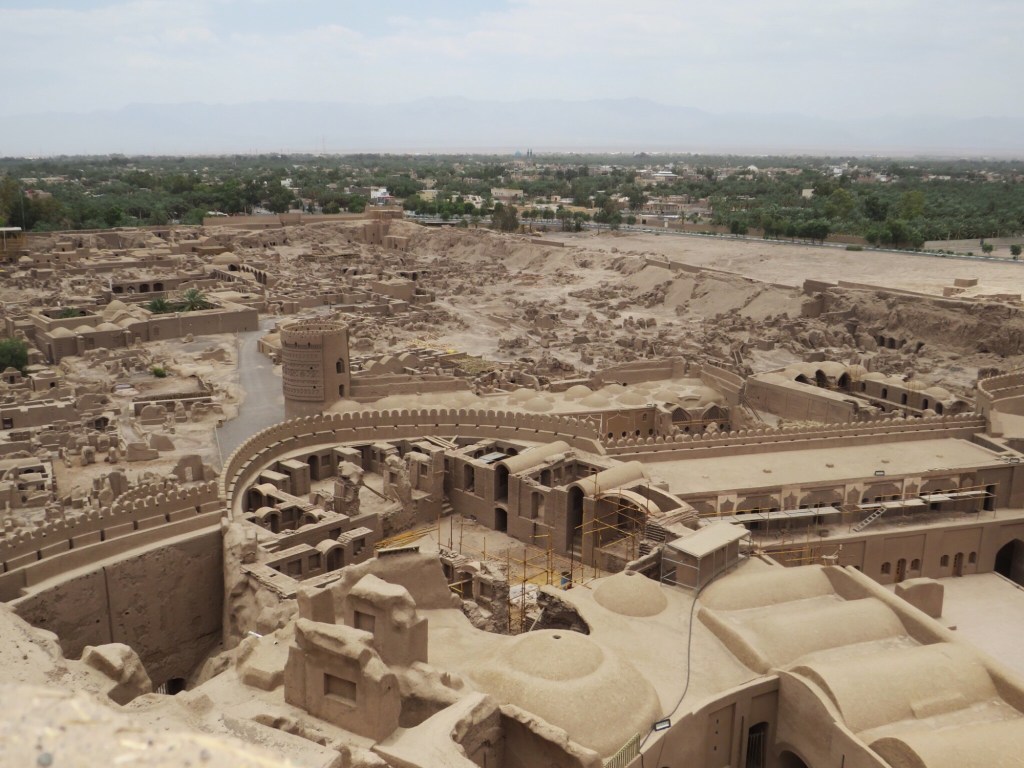
A couple of hours’ drive south of Kerman is the ancient city and citadel of Bam. It can be traced back to at least 600-400 BCE. The fortress was the biggest adobe building in the world but was severely damaged in an earthquake in 2003. Much of what you can see has been painstakingly rebuilt from fragments. Despite this, seeing Bam is a ‘wow’ moment. It is stunning—a beautiful and intricately decorated mud fortress surrounded by the ruins of an entire mud city. At least 2000 years of intrigue have happened within those walls.

Amongst the many fantastic adobe desert buildings, I loved Saryazd Castle, which is on the way from Kerman to Yazd. It was built in the 3rd-7th century Sassanian Empire. The last keyholder of the castle, Fatemah Ahangar Saryazdi, only died in 1993. Sadly, the castle was partly looted and trashed before it came under government protection.
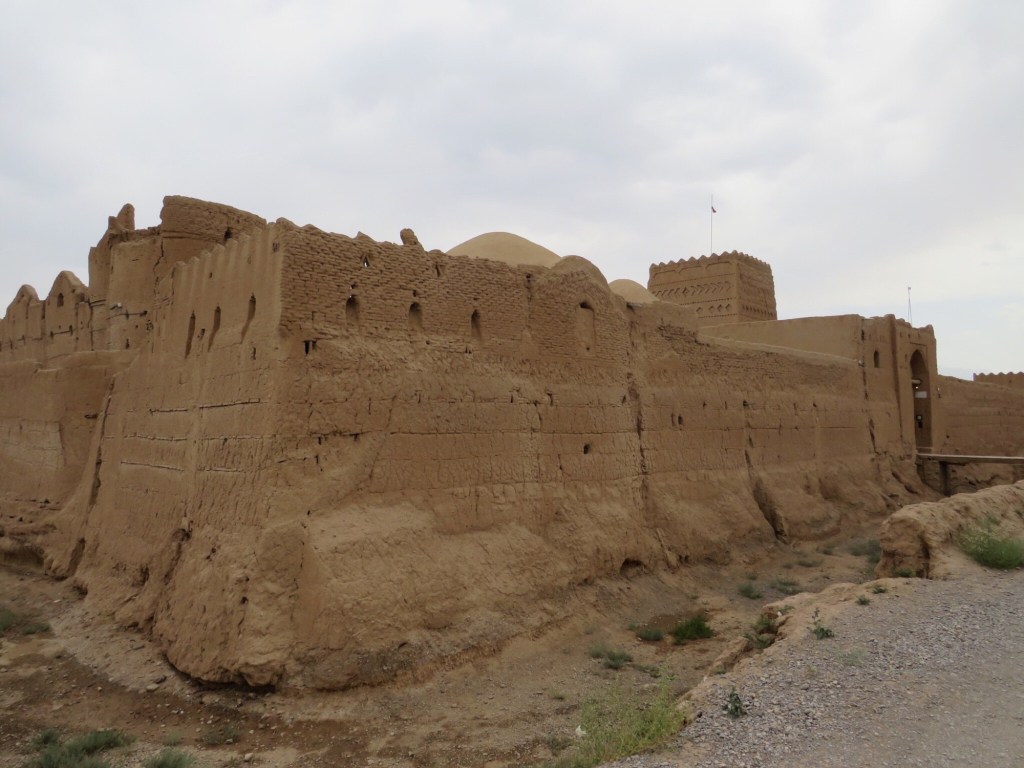
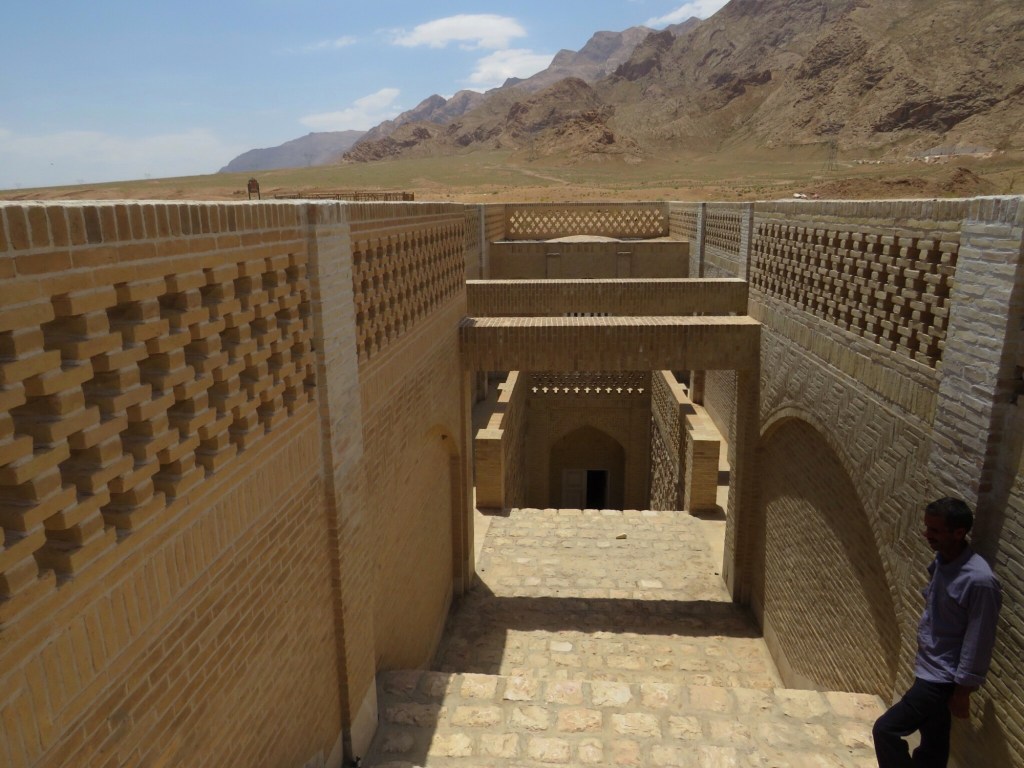
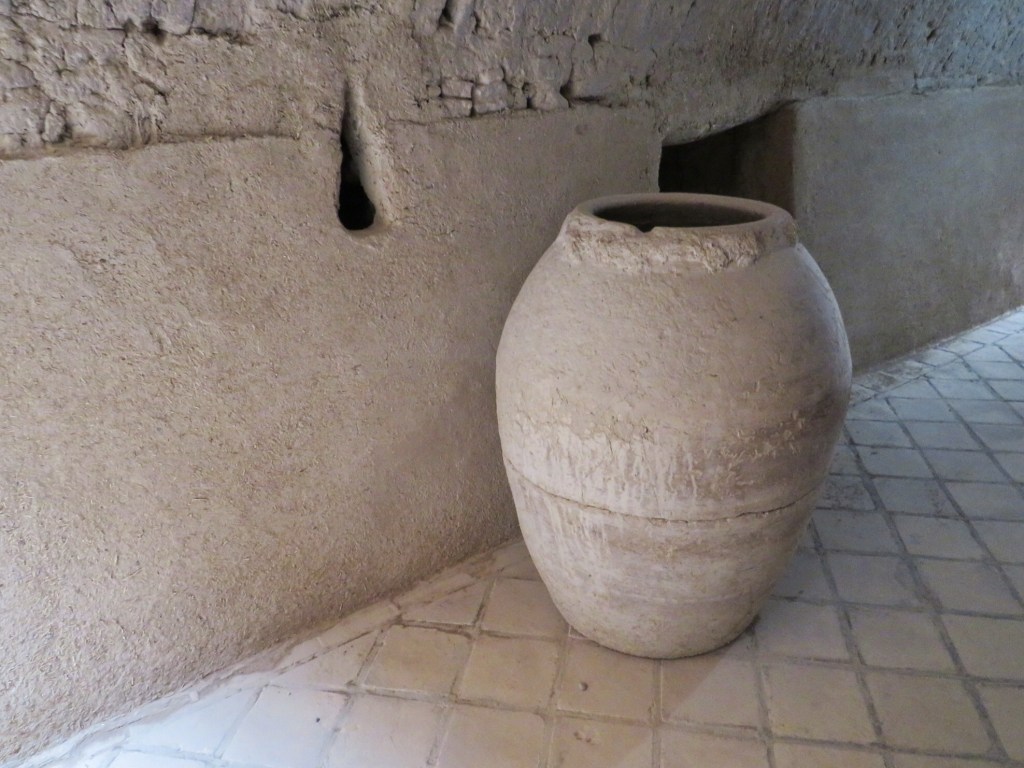
Saryazd Castle was like a bank vault on the old Spice Road. The sign outside says, “The largest and oldest safe deposit box in ancient Iran and the world.” It was heavily fortified with a moat, a drawbridge, double walls, and armed guards. It was set up for traders and locals to store their valuables, like spices, coffee, money, gold, and jewels. These were stored in sealed clay pots inside little clay rooms.
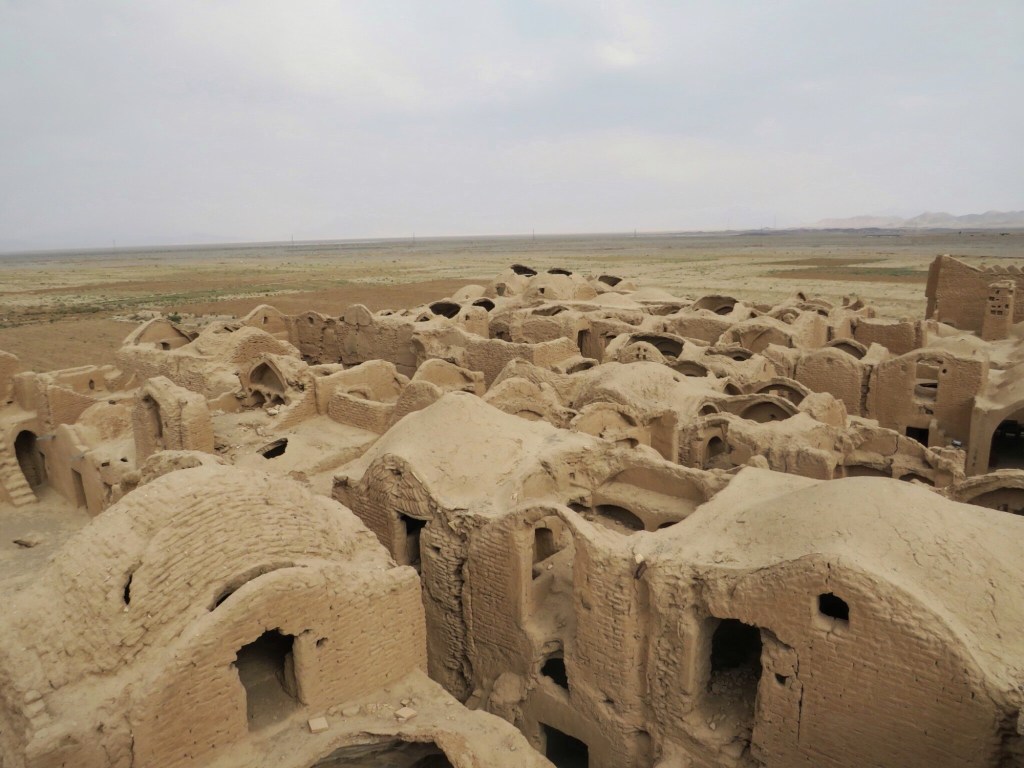
The historical adobe city of Yazd dates from around the 5th century. It’s almost entirely the colour of mud with extraordinary pops of turquoise. Yazd is uniquely adapted to the desert climate by having three levels. The narrow lanes at street level are partially covered, buildings have underground rooms, and the rooftops come alive at night with restaurants, cafes, and tea houses.

At night, many of the stunning buildings in Yazd are lit up in colour.
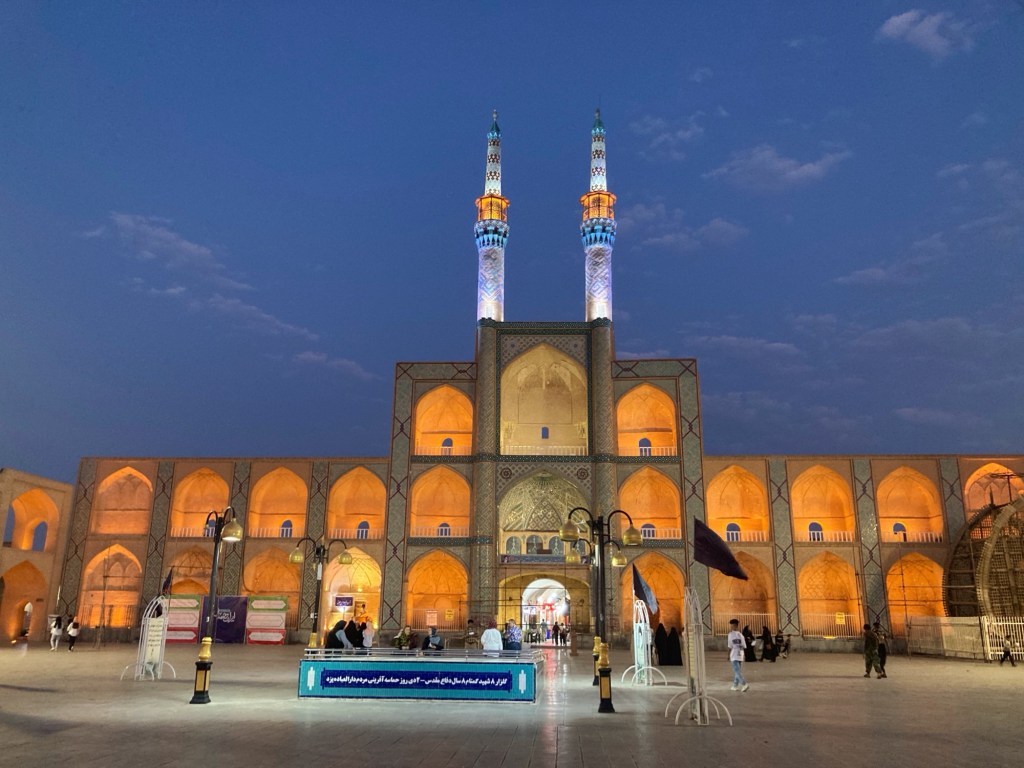
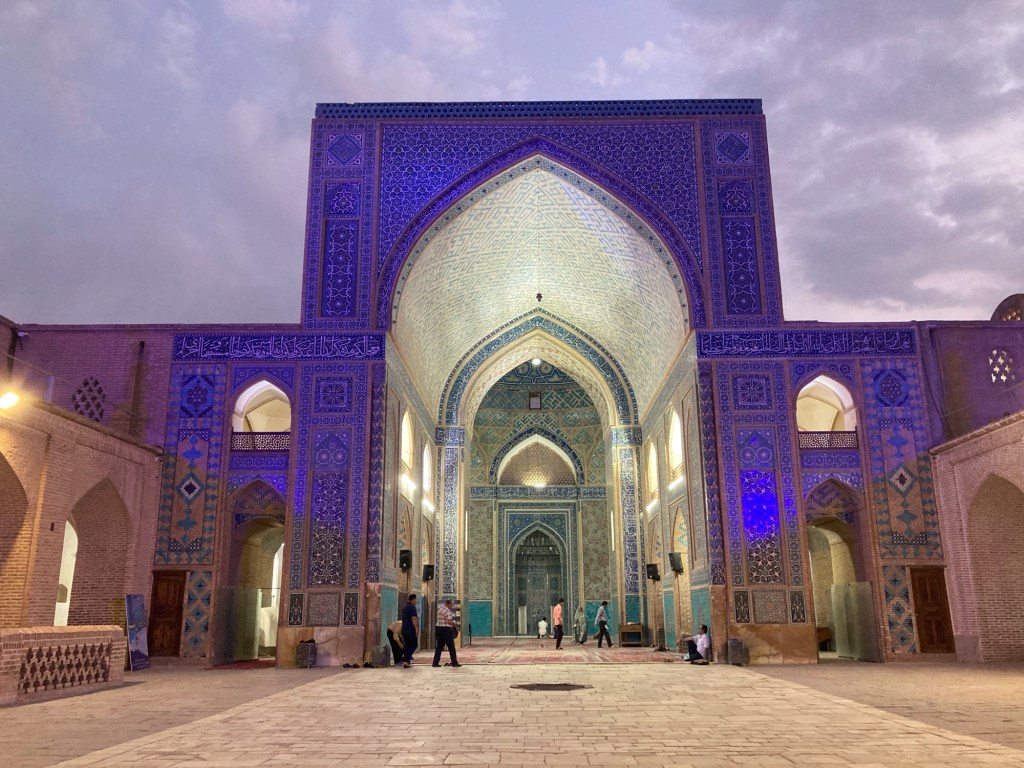
Another desert adaptation is the use of windcatchers, called ‘badgirs’. You see these all over Iran, but they are everywhere in Yazd. These ancient air-conditioners are tall towers that catch the wind and circulate it through the buildings below. Like everything in Iran, design and architecture is both functional and beautiful.
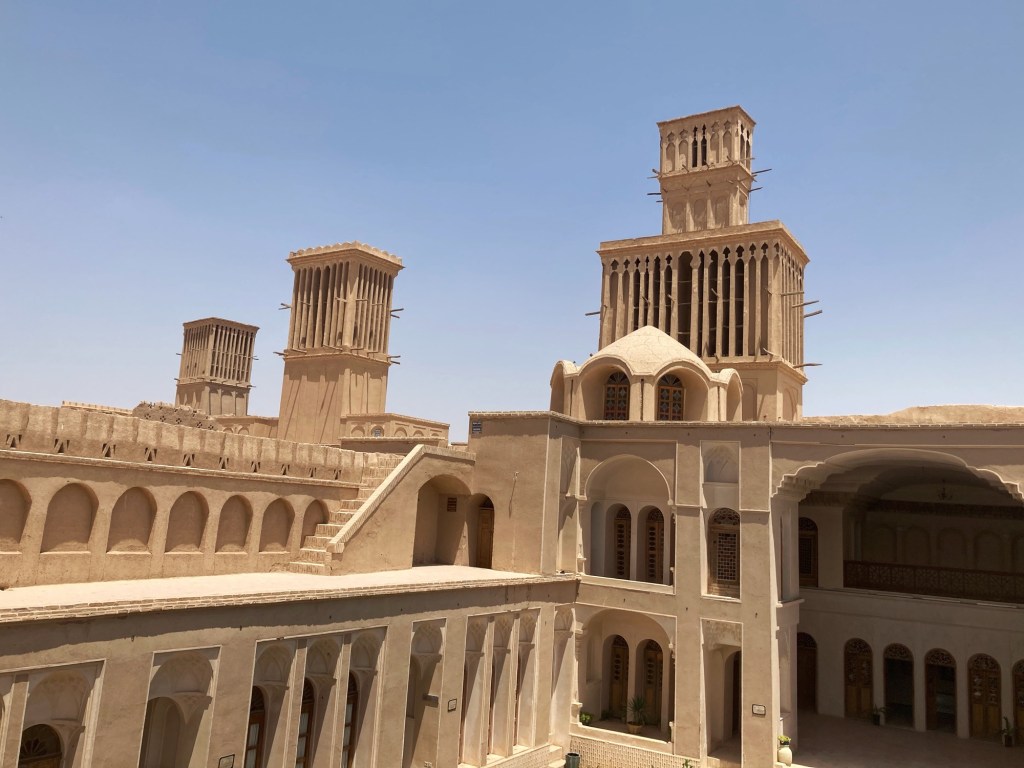
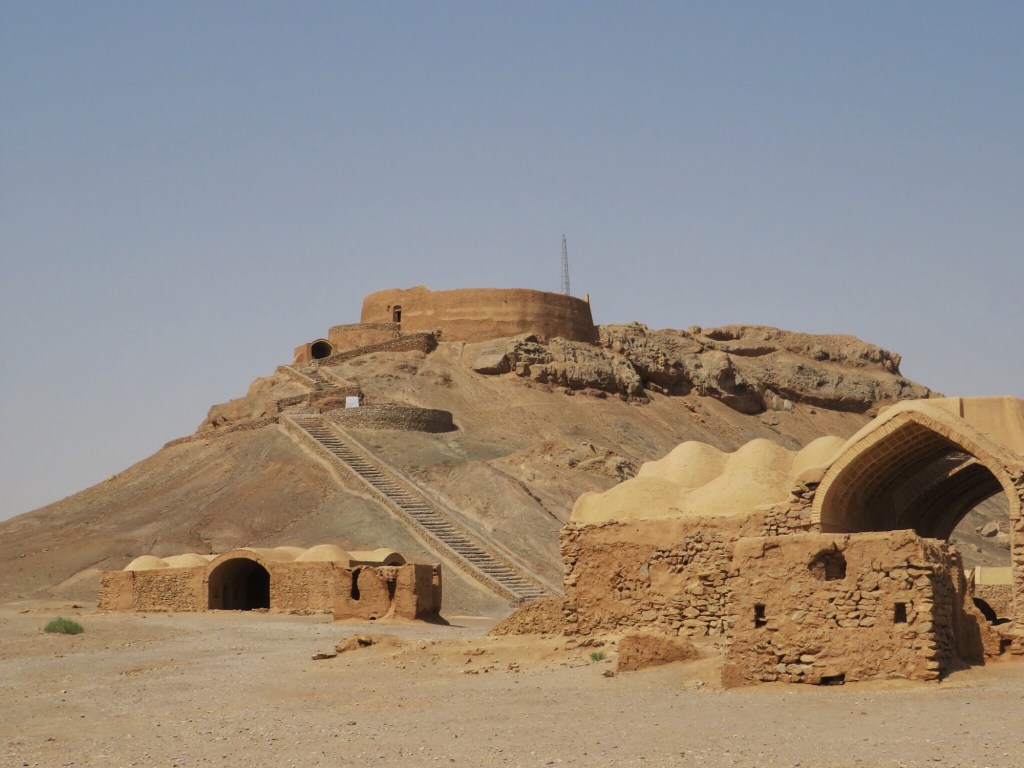
Yazd was always known as a safe place, providing sanctuary and acceptance for people escaping persecution. Many Jews and Zoroastrians fled to Yazd in the 7th century to avoid forced conversion to Islam from the Arab invasion. A lot of Zoroastrian sites were destroyed, but the Towers of Silence outside Yazd continued operating until 1966. Zoroastrians believe the elements of fire, water, earth, and air are sacred, so they avoided polluting them with dead bodies. Instead, they would take their dead to a tower of silence where waiting vultures would eat the body. Apparently, vulture saliva kills bacteria and diseases, and unlike other flesh-eaters, they eat everything in situ and don’t drag the body away or leave bits of it lying about. Sadly, when chemicals were introduced into agriculture in (I think) the 1960s, most of the vultures died.
It felt like an honour to climb up to the top of the tower and see where it all happened. Only one person, the ‘Nasar-Sala’, was allowed to enter this area. He would take the body inside and unwrap it before leaving it for the vultures. He’d return later to throw the bones into the pit in the centre. It was so easy to picture this while standing on the tower, looking at the walls where vultures used to sit, and gazing into the bone pit.
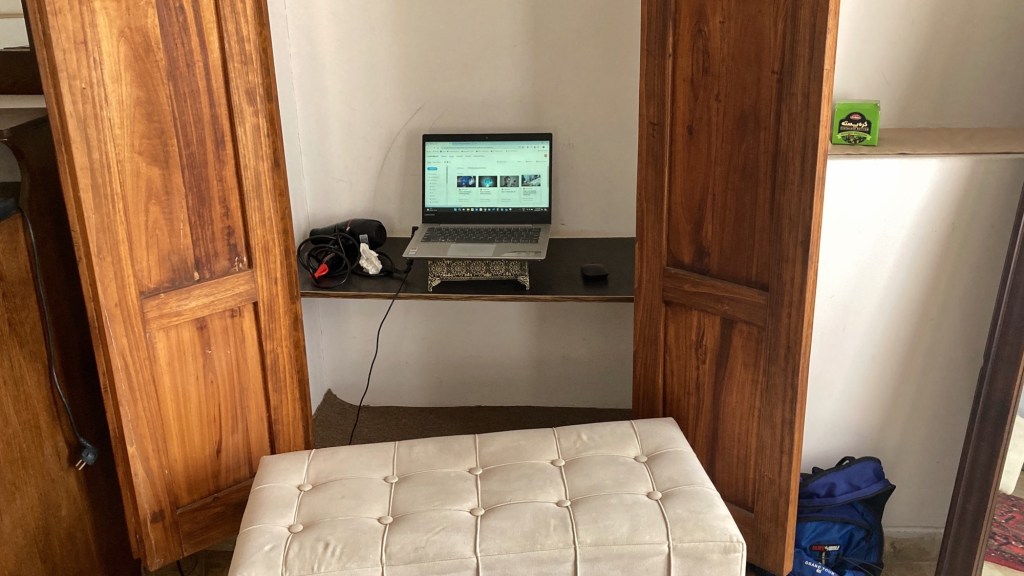
While staying in Yazd, I didn’t have a desk or table, so I had to work on a shelf inside the cupboard with my laptop balanced on a tissue box. Sometimes, this digital nomad business isn’t all it’s cracked up to be.
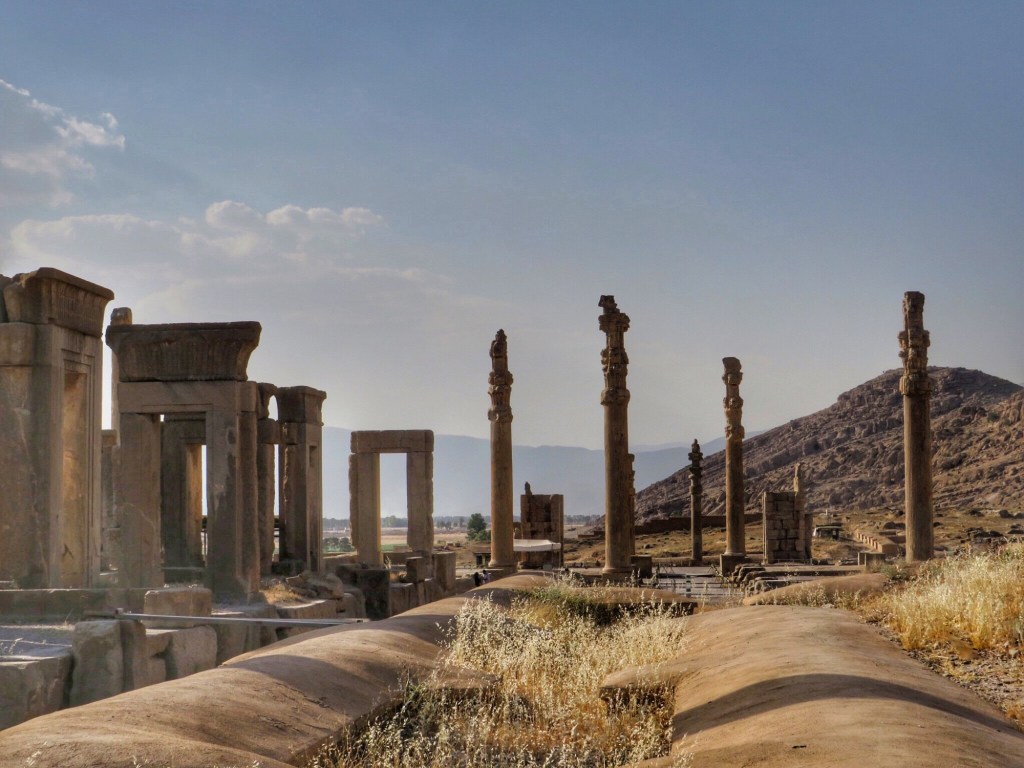
After Yazd, I finally achieved my childhood dream of visiting the ruins of the 2,500-year-old Persian capital of Persepolis. Alexander the Great burned it to the ground in 330 BCE, leaving only the stone remains. You can still see the fire stains on the limestone.
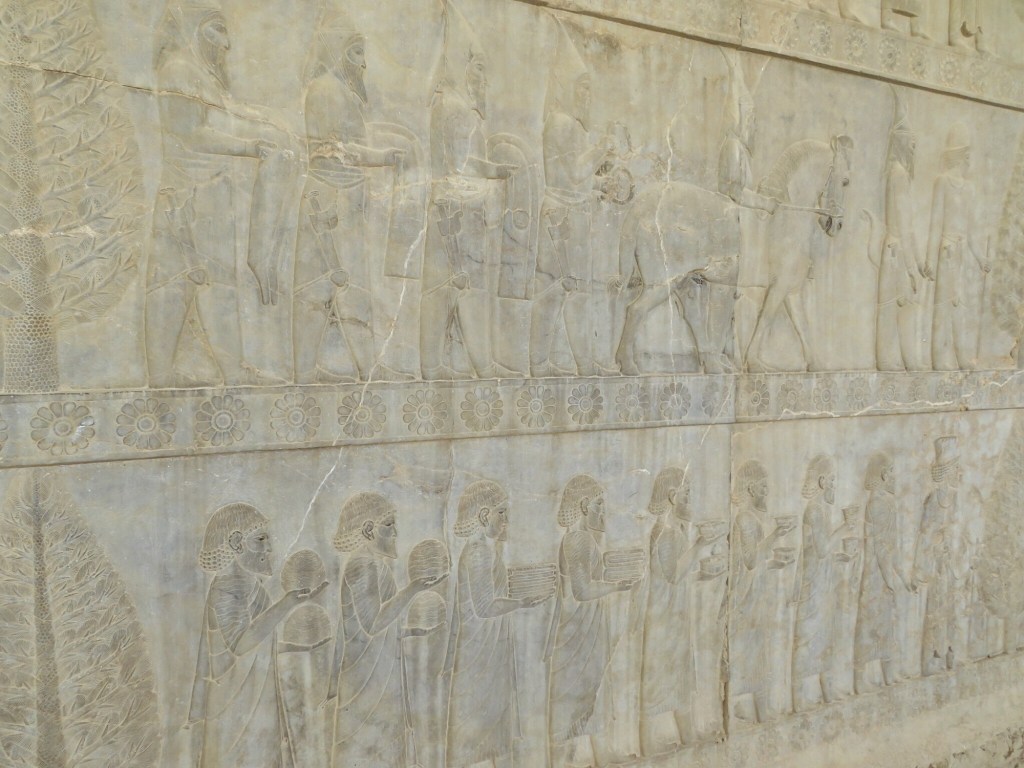
Persepolis is less intact than I’d hoped, but the stone carvings are amazing. There are so many, but I think the most interesting are the walls depicting people from all parts of the empire bringing gifts to the ‘King of Kings’. They are so detailed that you can see the different cultural dress styles and identify the specific gifts each region was famous for, such as wine, honey, or cloth.
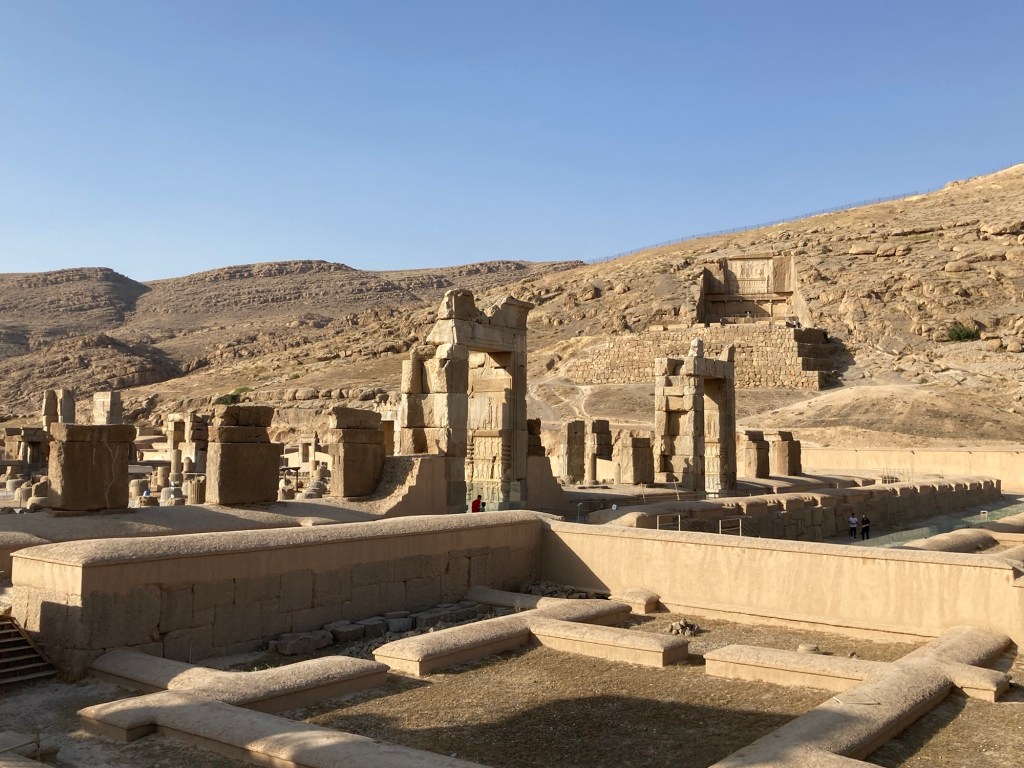
Nearby is the fascinating necropolis, Naqsh-e-Rustam, with the tombs of the ancient kings carved into the mountain. You can actually see some of the tombs up above Persepolis.
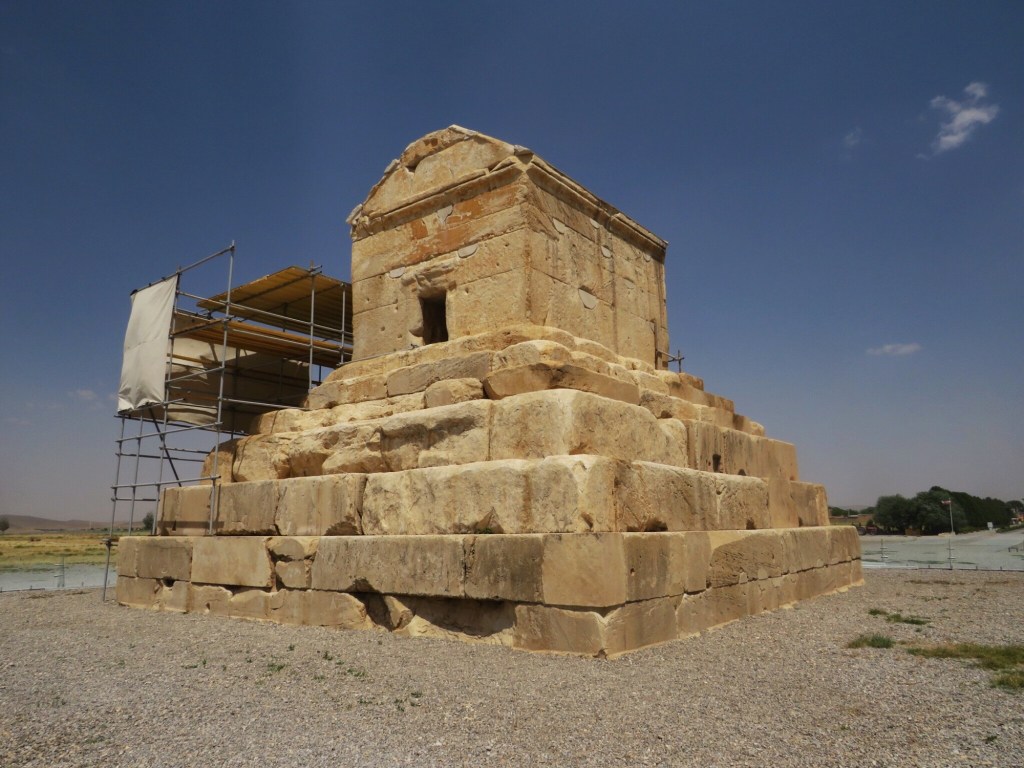
Not far from Persepolis at Pasargadae is the simple tomb of Cyrus the Great (600-530 BCE). He seems to have been a lot nicer than your average king, respecting the cultural and religious diversity of places he captured and freeing all the slaves. He is credited with creating the first charter of human rights, which was written in cuneiform on a clay cylinder.
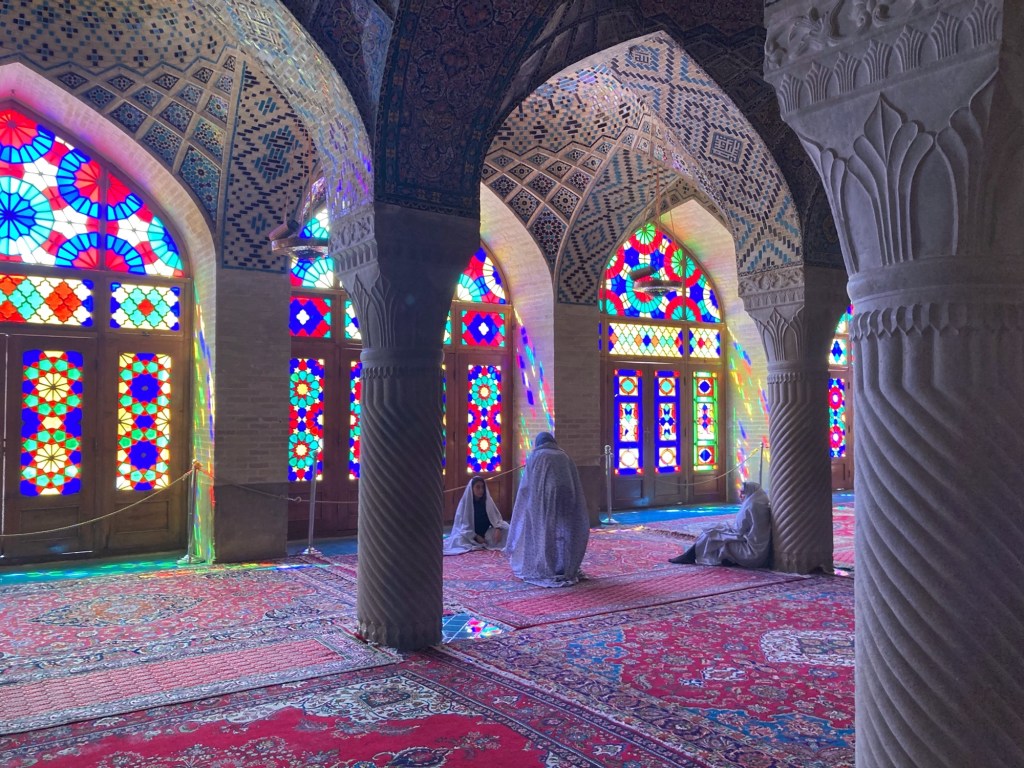
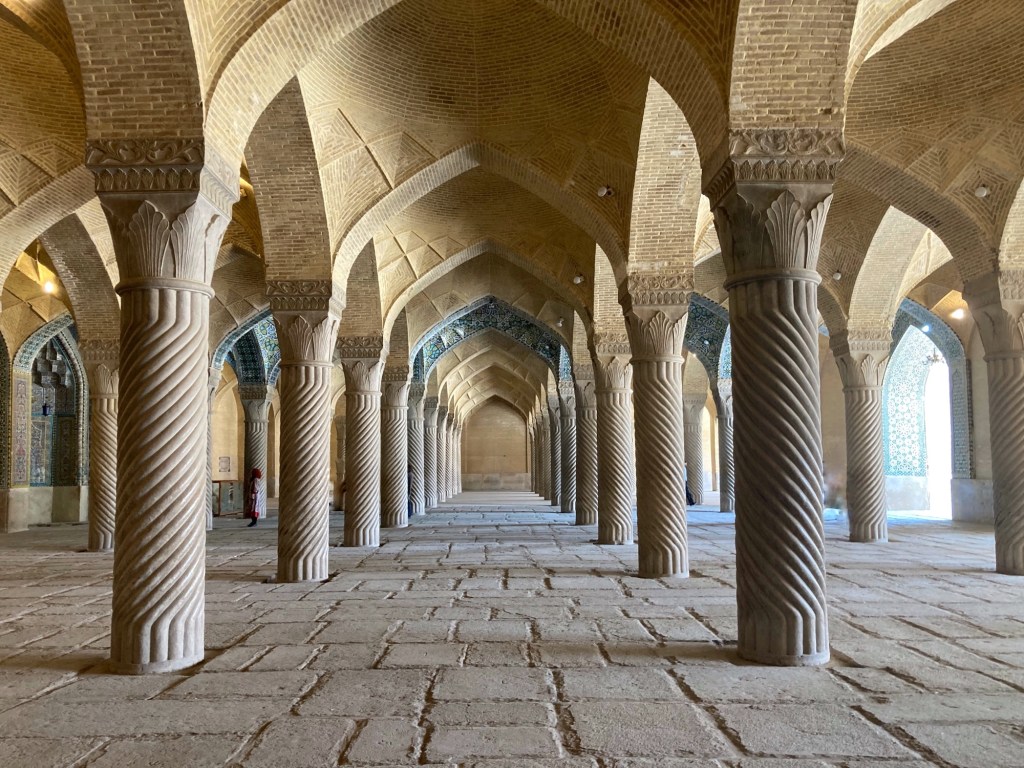
Our next base was in Shiraz, the city of poets, literature, and flowers. It was a bit greener and slightly cooler than anywhere else we’d been so far. I loved Shiraz because of its more liberal and lively culture. I think its enormous bazaar is the best place to shop in all of Iran, especially for clothes. I felt the softest, most luxurious silk velvet ever there and will always regret not buying it. That’s the downside of travelling light. Apart from visiting the famous mosques (two of the most beautiful in Iran), we spent a lot of time sitting in Vakil Square, eating good food, drinking good coffee, people-watching, and absorbing the atmosphere.
You see more women in Shiraz without their heads covered than anywhere else, especially women under 25. One day, I was sitting in the square when a gang of women in black chadors came and told me to put my hijab on. Uh-oh, it was the morality police. There was an instant outpouring of solidarity from everyone around me. People were giving them rude signs behind their backs and apologising to me. They are very unpopular. We watched to see how other women reacted. Many of them refused to cover their heads, scowling at them and saying what I imagine was the equivalent of “fuck off”. Eventually, though, everyone did resentfully put their hijabs on. There is a cultural revolution happening in Iran, and the vast majority of Iranians want more freedom and think the hijab should be optional.
I learnt that there are lots of different sects within Islam, but the major split is between Sunni and Shia/Shi’ite Muslims. This is kind of similar to the split between Catholics and Protestants in Christianity. Very simplistically, most of the world (over 85%) is Sunni. Iran is Shia. Saudi Arabia and Iran are the two major powers in the Islamic world. Just as Saudi Arabia (Sunni) supports the Taliban and ISIS (both Sunni), Iran supports Hezbollah in Lebanon and the Houthi movement in Yemen (both Shia). The USA and Saudi Arabia are allies (Hint: it’s about oil). Of course, it’s much more complex than that, but it does help make sense of some of the tensions and conflicts in world politics.
Our next stop was in beautiful Isfahan. Just the name ‘Isfahan’ evokes a sense of the exotic and it has long been considered one of the most beautiful cities in the world. Its beating heart is the massive Naqsh-e Jahan Square. You can see in the video below that although the ‘Call to Prayer’ is in progress, noone is taking any notice. Recent research, which aligns with what everyone I asked said (and I asked everyone I met), shows that only around 30% of Iranians are now practising Muslims.
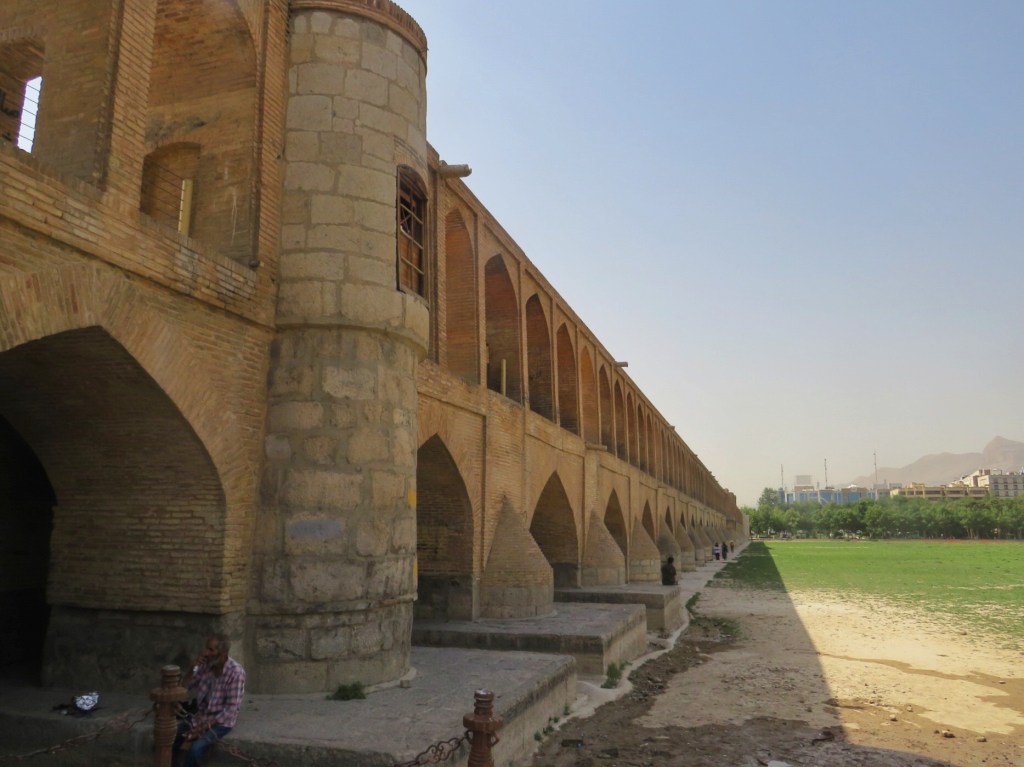
If the Naqsh-e Jahan Square is the heart of Isfahan, then the Zayandeh Rud (river) is its soul. Without this river, Isfahan would never have existed. There are nine bridges across the river; some are architectural masterpieces in their own right. Sadly, the river is being diverted to other areas that have run out of water due to climate change, falling water tables and changing usage patterns. It is incredibly heartbreaking to see the bridges spanning the dry riverbed. Approximately two-thirds of Iran is predicted to be uninhabitable within twenty to thirty years.
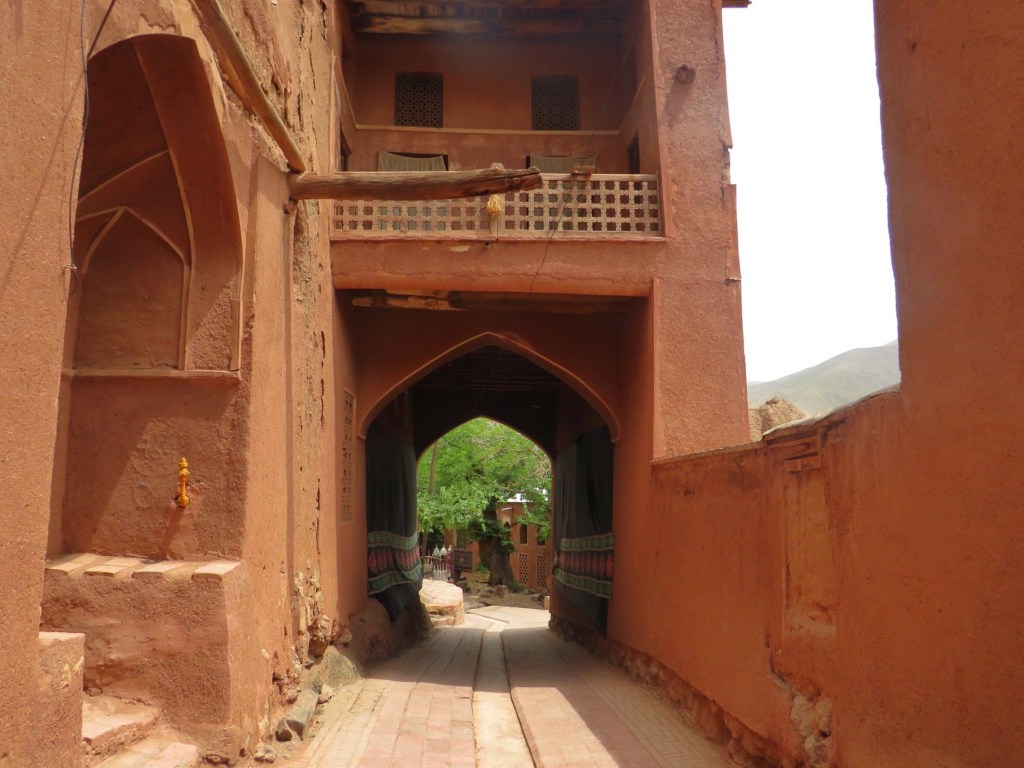
North of Isfahan is the 1500-year-old picturesque village of Abyaneh, with houses stepped into the slopes of the Karkass Mountain. It’s called the ‘red’ village because of the pretty ochre colour of its clay buildings. The village has its own distinct culture, dress, and ‘Old Persian’ language. The story we were told is that it was isolated for hundreds years and didn’t notice that the rest of the country had changed. Imagine their shock. Apparently, once they were back in contact, they had a look at all the changes that had happened around them and decided, “No thanks, we’ll just carry on as we are”.
We decided to take some time out in the small oasis city of Kashan that’s famous for its beautiful old mansions. It really is a lovely place and people were so friendly that we started to feel like locals. It is one of the most conservatively religious places we went to and most women were wearing the black chador. Women seem to be comparatively respected in Persian culture, which is very family-focused, and there is none of the macho posturing you see in many other countries, such as Australia. Of course, despite the many positive things about Islam (and there are many), it is still a patriarchal religion, like Christianity and Judaism, and therefore fundamentally sexist. I mean, an omniscient male god? As if.
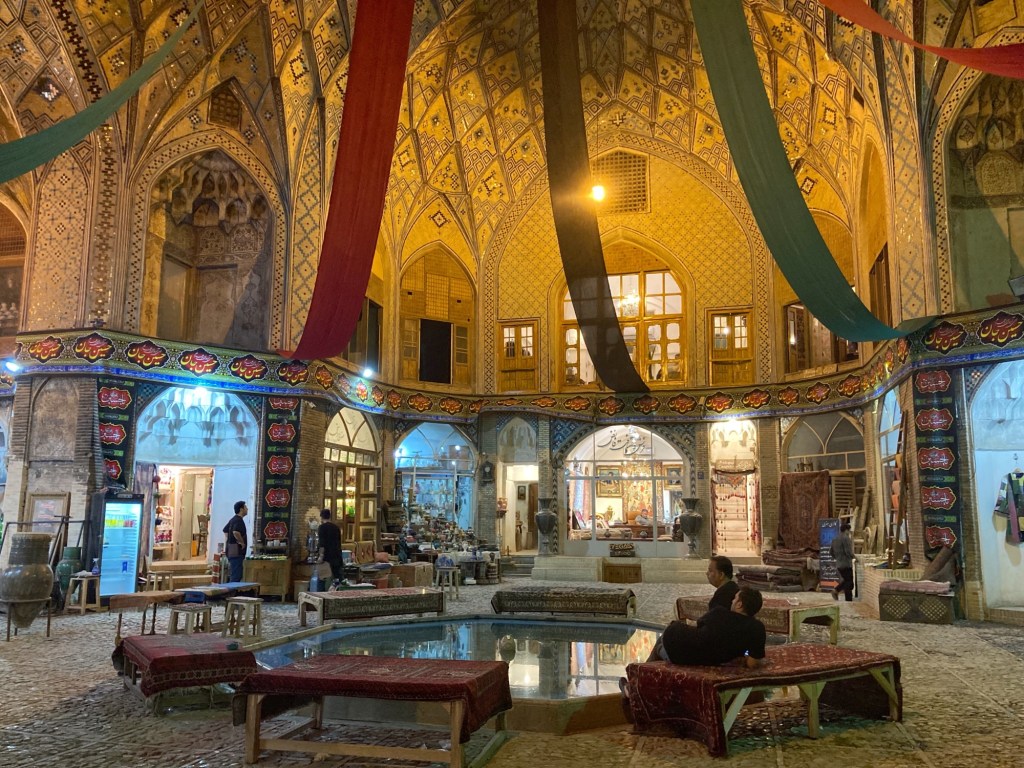
Kashan’s historic bazaar is perhaps not as flash as some others but there are hidden wonders. I was in raptures when we came across this perfect caravanserai.
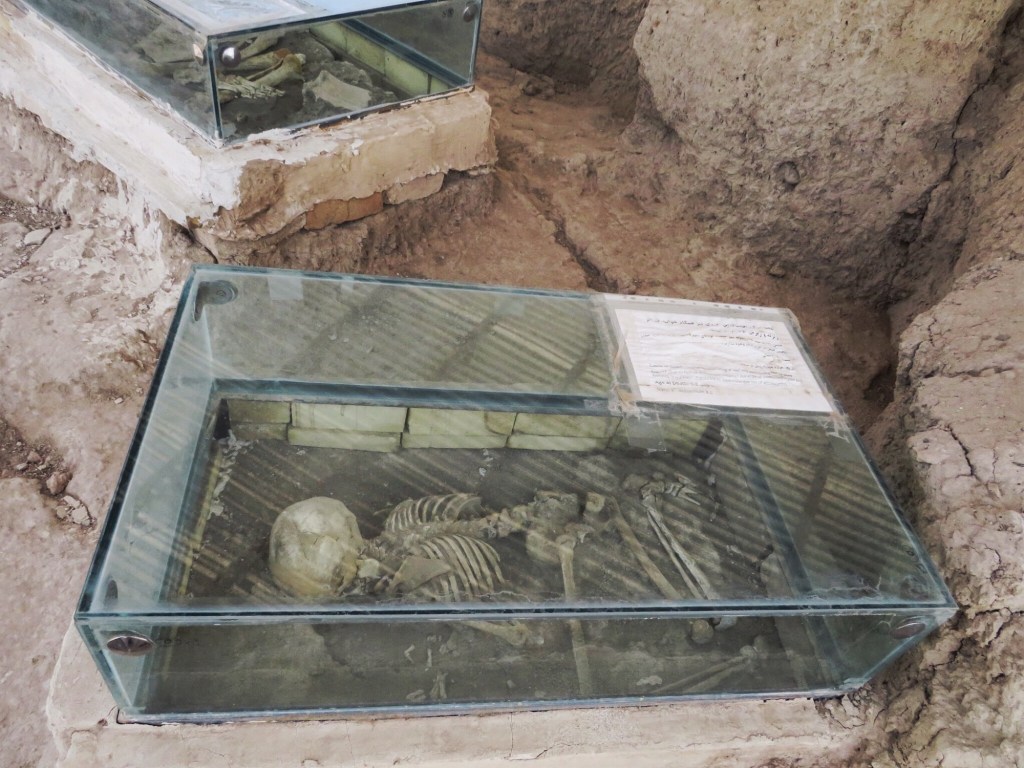
I’m not all that interested in modern history, but ancient history makes my heart beat faster. A really intriguing place in Kashan is the archeological site of Sialk Tepe. It has layers of settlements that date back to 6000 BCE. Apart from the usual pottery and other artifacts, they found bodies buried in large urns and scattered skeletons of people that met an untimely death, probably in an earthquake. It blows my mind looking at the physical remains of people who lived so long ago.
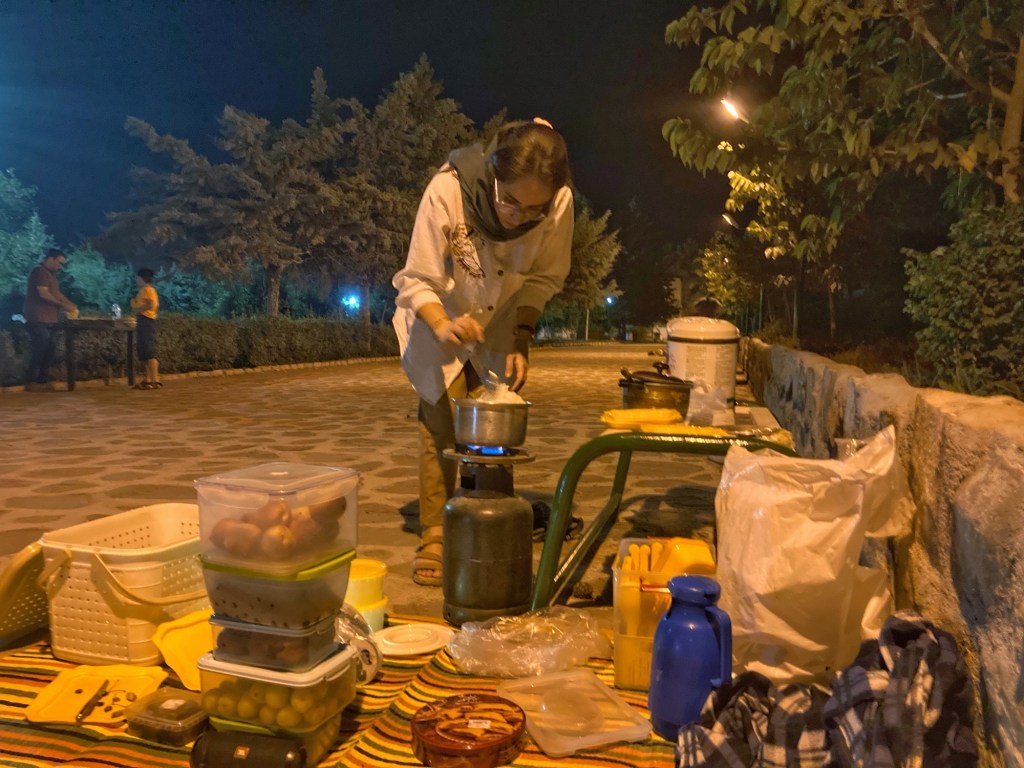
The best thing about Kashan, though, was Ebrahim. He started as our guide and became our friend. He wanted to take us for a picnic. Iranians love picnics and barbecues. Any spot of shade you see is bound to have a family sitting in it having a picnic. Most places shut down in the afternoons because it’s just too damned hot, so a lot of Iranian life happens at night. Ebrahim picked us up at 11 pm with his wife, Beta, his son Mehrdad and a mountain of food. Then, we drove for about an hour to a nearby village that was a bit cooler. There were lots of other families there having midnight picnics, too.
We were waiting to go to Tehran until after the general election. Everyone said there wouldn’t be any trouble, but we were nervous after the horrific brutality of the government response to the ‘Woman, Life, Freedom’ protests. Everyone in Iran was also horrified by that. When I asked people about the election candidates, they said (direct quote), “They’re all bastards.”. It was generally agreed that one was less of a hardline bastard than the others. Luckily, he was the one who won.
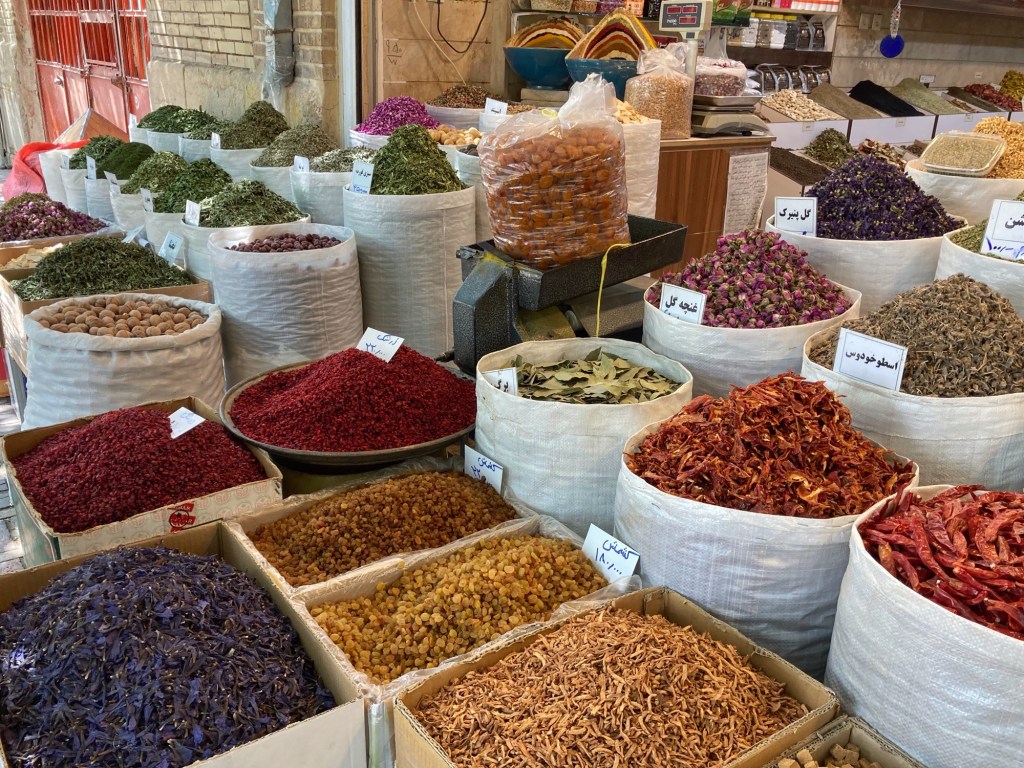
A big highlight of our time in Tehran was having a fantastic vegetarian restaurant just around the corner. Persian food is an adventure on its own. The portions are huge, and one meal was plenty for two of us. Fruit, nuts, flowers and unfamiliar spices are used in unusual flavour combinations, and nothing tastes as you expect. Most of the time, it’s a delicious surprise, and occasionally, it’s “hmm, not sure about that one”. The fruit and nuts are incredible – pistachios, peaches, cherries, apricots and melons really do melt in your mouth. Icy green rockmelon (cantaloupe) juice and fragrant Persian tea in tiny little cups with ‘nabat chuby’ (little swizzle sticks of crystallised sugar and saffron) are some of the best things ever.
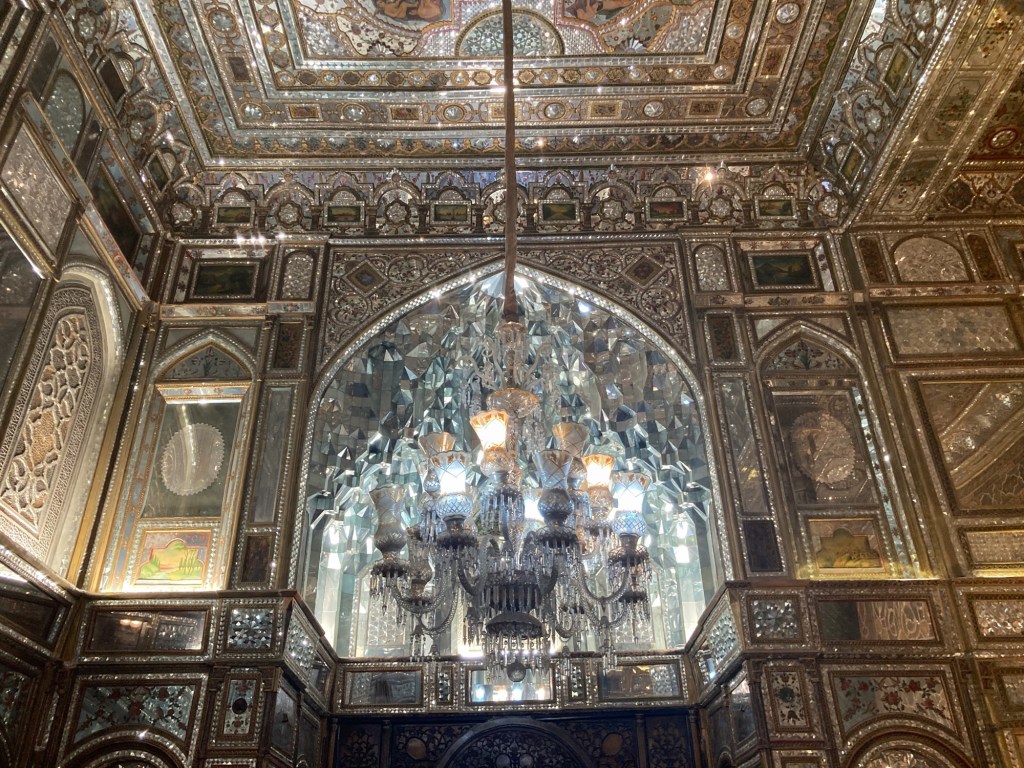
The ‘must-see’ in Tehran is the incredible Golestan Palace. Most of it dates from the 18th to 19th centuries, so it’s not that old, but it really is exquisite. After that, we saw the Treasury of National Jewels, which included the famous Peacock Throne. Between the two, I saw more gold, precious stones and shiny things in one day than I’ve seen in my entire life.
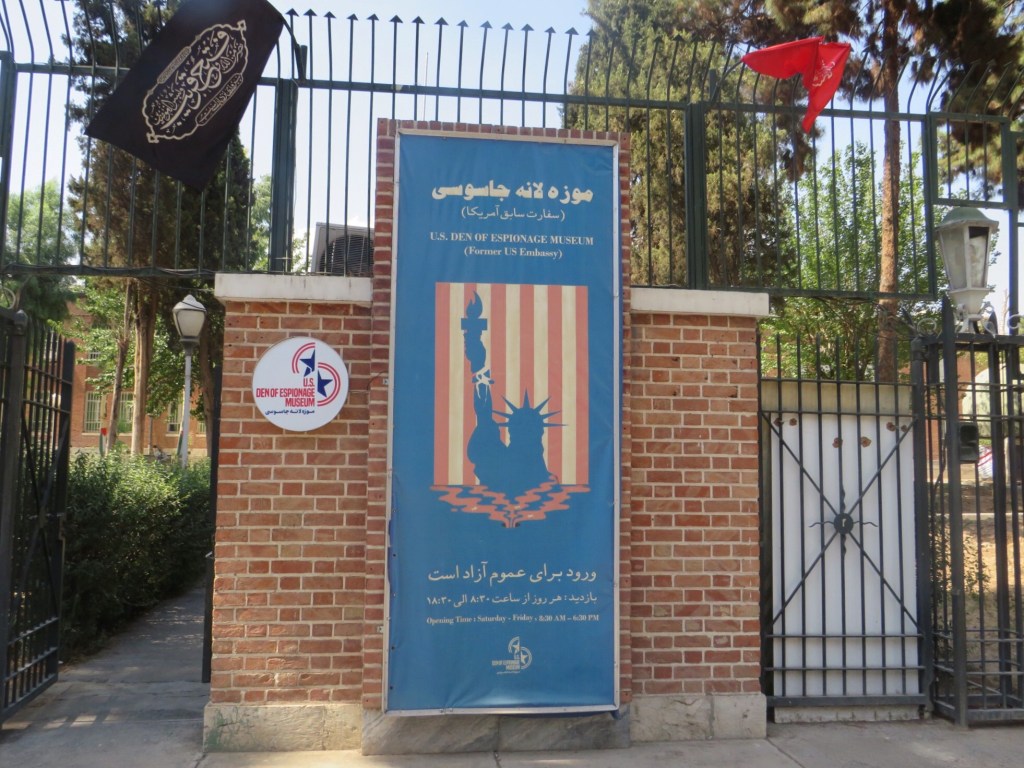
Visiting the former US embassy in Tehran was so interesting. It’s now the US Den of Espionage (Anti-Arrogance) Museum. It’s very well done. It’s creative and sometimes irreverently funny. I vaguely remember the Iranian hostage crisis of 1979-1980. Just after the Islamic Revolution in Iran, a group of university students walked into the US embassy in Tehran and took almost the entire staff hostage. In exchange for the hostage’s release, the students demanded the US government agree to stop meddling in Iran’s internal affairs (which, of course, they had been) and to return the deposed Shah of Iran, who was in the US, to face trial for corruption and human rights abuses. The US refused, so the hostage situation continued for over a year. None of the hostages were killed or mistreated, and eventually, the US agreed to most of the student’s demands, and the hostages went home. However, the US lost face and has been sulking with Iran ever since.
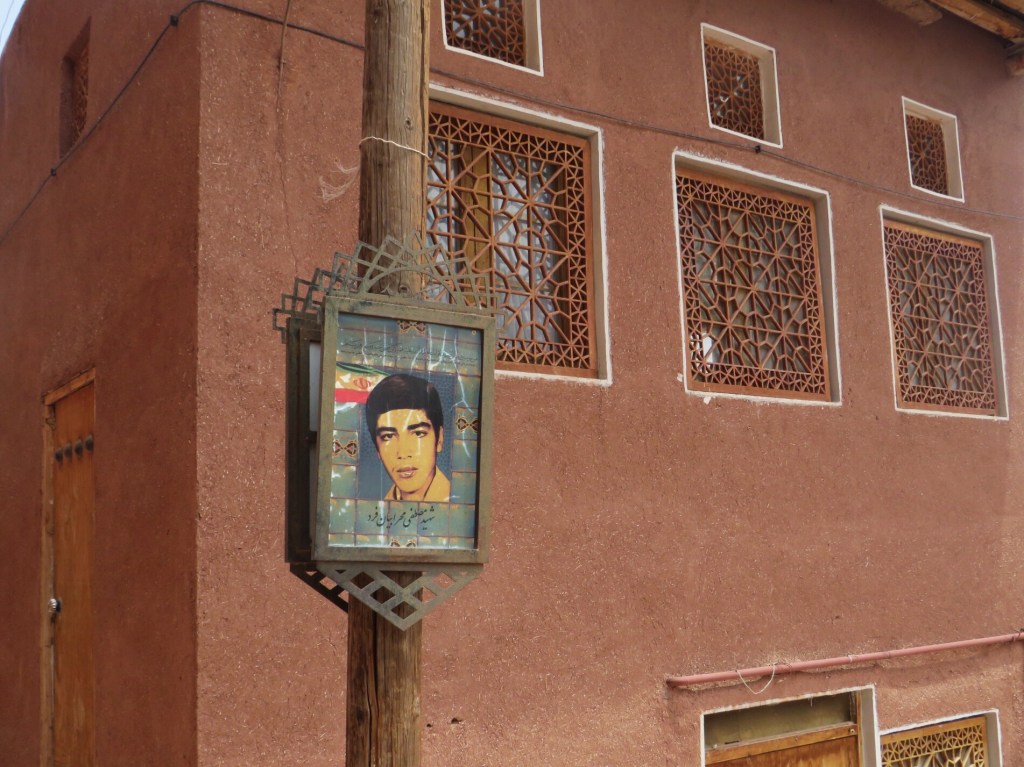
Not long after this hostage fiasco, in 1980, Saddam Hussein and Iraq invaded Iran. Iraq was supported by the USA and all of its allies. The Iran-Iraq war lasted for eight years. There are photos of the people (martyrs) who died in the war everywhere, all along the streets and highways. It’s very sad and personal.
We caught the overnight train from Tehran to Tabriz. Train travel is so cheap. We booked the whole 4-person cabin with four beds for the equivalent of €30. Tabriz is a bit different to everywhere else we went in Iran. The culture is a mix of Azerbaijani, Persian and Turkish, who speak mostly Azerbaijani. They’re very friendly, and people constantly stopped us on the street for a chat. It’s much greener in the northwest, although the river is just a trickle. It’s also a bit cooler but still too hot to go out in the afternoon.
Tabriz is famous for its bazaar, one of the oldest and largest covered bazaars in the world. The alleys have branches that lead to outdoor squares or open up into beautiful indoor courtyards, mosques, or caravanserais. We were lost in there for hours.

You’d think we’d be sick and tired of beautiful mosques by this stage. In fact, we were, and JH didn’t want to go, but I thought, ‘Just one more’. The 15th-century Blue Mosque in Tabriz doesn’t have the shiny glitz and glamour of many others but is architecturally stunning, with arches, alcoves, and simple tiles in so many shades of blue. Some places feel spiritual, and the Blue Mosque is one of them. It’s both grounding and uplifting and one of my favourites.

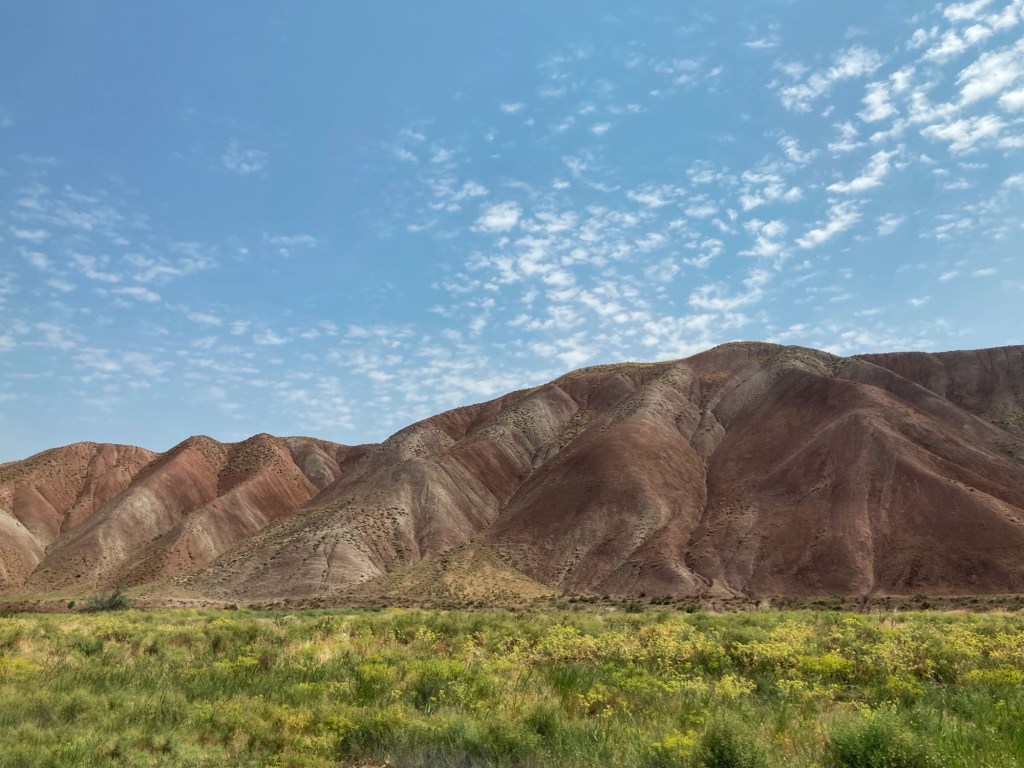
With our 45-day visa expiring, we got a taxi for the four-hour drive from Tabriz to Bazargan on the Turkish border. The road travels along the edge of Armenia and the Autonomous Republic of Nakhchivan. The landscape gradually became greener and more cultivated. Along the way, we saw the Aladaglar Rainbow Mountains, which are so pretty they don’t look real.
Everyone says that regardless of all the wonders, the thing they love most about Iran is the people. Now I know what they mean. Iranians are beautiful people. They’re honest, kind and ‘real’. No one is trying to rip you off or sell you anything. People are genuinely interested and want you to have a good time. It’s very refreshing and humbling.
When we arrived in Bazargan, the taxi dropped us off in the middle of nowhere, miles from the actual border, and we started walking with our packs in the relentless heat until the miracle of another taxi appeared. It was complete chaos at the border. There was a huge queue with so many people. Everyone kept passing us forward up the queue while shouting “tourist!” or “Australian!”. It was very kind of them, but eventually, we ended up in a ridiculously crowded corridor, hemmed in on all sides with our noses squashed up against the people in front. The border control had gone for a long lunch, and we were stuck like this for ages. Eventually, they opened the gate, and we all poured out into the next queue, where the whole process was repeated. This happened a few more times until we finally crossed out of Iran and into Turkey, where the same process started all over again.
There are more photos from Iran here.
 Adventurous Hermit
Looks absolutely incredible.
LikeLiked by 1 person
It is amazing 🙂
LikeLike
Iran has been a dream for so long!! Your post confirms what I know about the country and its people, its just so sad that the majority of people (like my family), believe western media and think if I ever went I’d be killed. Thank you for showing us the real Iran. Maybe I’ll get there one day!
LikeLiked by 1 person
I do hope you get there Anna. It’s such an amazing country.
LikeLiked by 1 person
wow, thanks so much for your amazing blog, I so much enjoyed reading. Iran, what an interesting place that I really knew nothing about, now I want to go there…..& great photos xxx
LikeLiked by 1 person
Thanks Val 🙂. You should definitely go! It’s a fascinating country xxx
LikeLike
Hi Jeanne,
your travels in Iran look amazing. Your descriptions and photos took me there with you.
i cant wait to see what Turkey brings.
Stay safe,
Julianne xxxx
LikeLiked by 1 person
Thanks Jules! Iran is an amazing country xxx
LikeLike
Wow … you took me there Jeanne. Wonderfully inspiring adventure. Thank you for sharing your experiences and photos. Vicki M
LikeLiked by 1 person
Thanks Vicki 😊. I’m glad you enjoyed it and thanks so much for commenting.
LikeLike
Wow Jeanne Iran sounds amazing and not at all what we hear here. I love those pics of the mosques ❤️
LikeLiked by 1 person
It was completely different to what I expected Liz x
LikeLike