
We were the only people crossing the Attari-Wagah border when we walked across from India to Pakistan. The immigration halls on both sides were completely empty, apart from the staff who were overjoyed to see us. It seems a lot of people come to cheer the border closing ceremony but not many actually cross over. There’s been on-and-off conflict between the two countries since the 1947 Indian partition, and there’s still a lot of suspicion on both sides.
We were immediately besieged by currency changers when we exited in Pakistan. This was handy because we didn’t have any Pakistani money. Once we’d changed a little bit at an appalling rate, we thought we’d share our good fortune with the poor old toothless guy waiting there with a trolley. He piled our packs into his trolley and set off at a cracking pace, then demanded way too much for his trolley service. When we reached the carpark, there was a single car claiming to be a taxi. He wanted way too much to take us to Lahore. Things got much better after that.
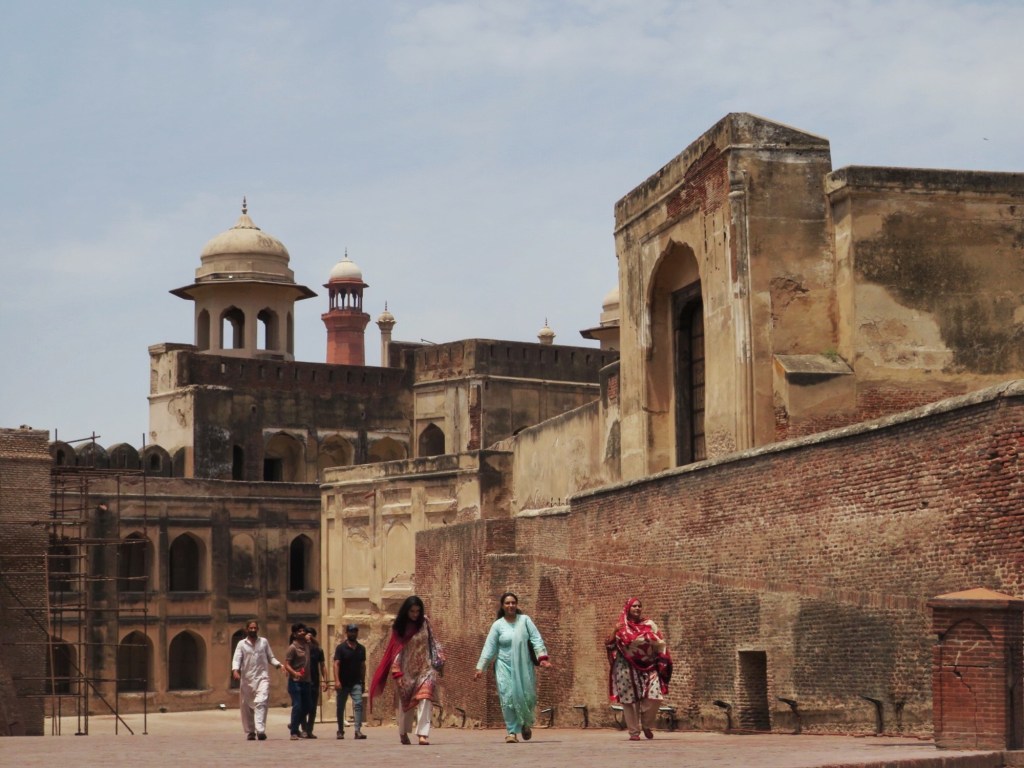
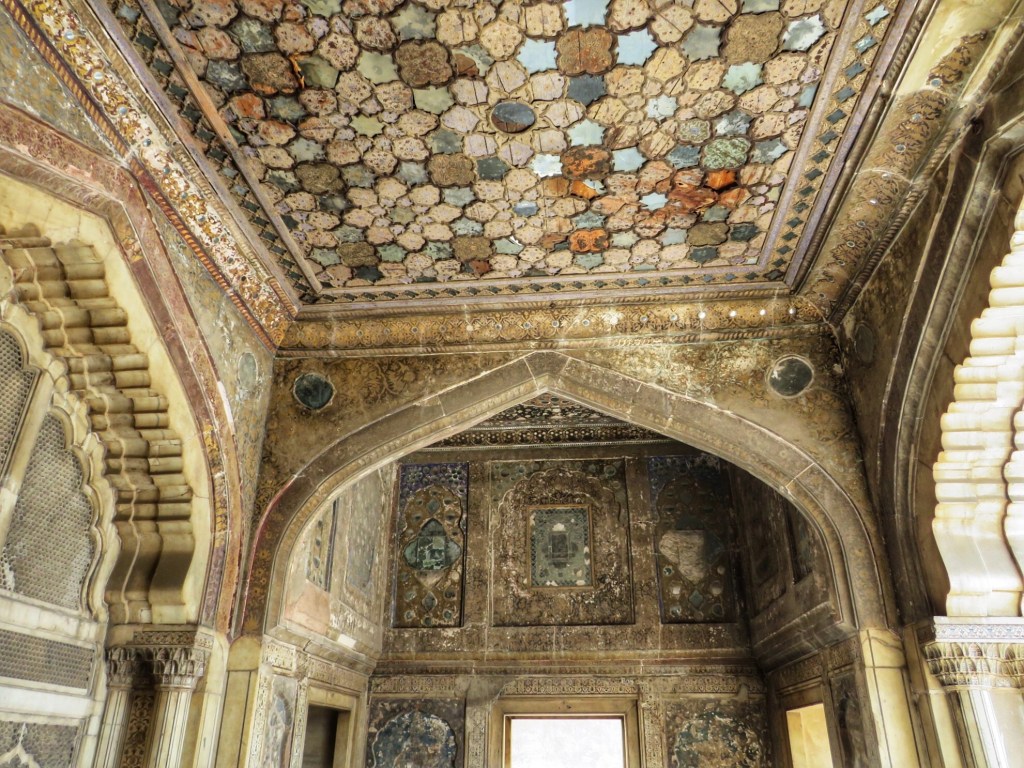
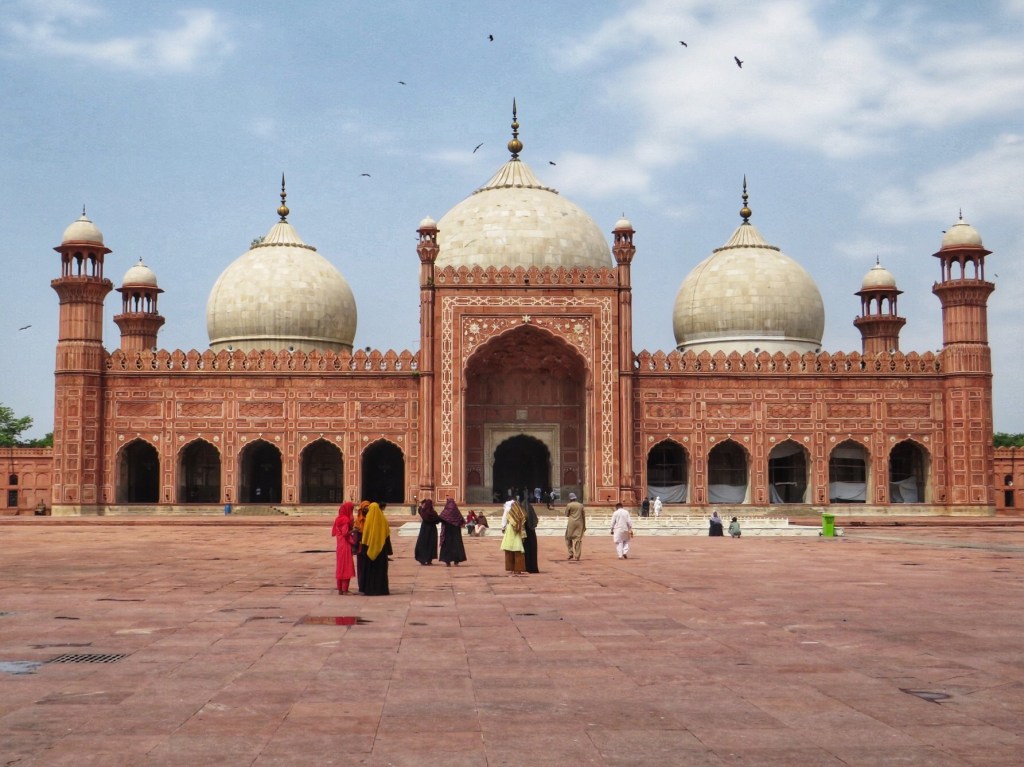
Although Lahore is over two thousand years old, the incredible UNESCO heritage buildings are mostly from the 16th-18th century Mughal Empire. The contrast in the shapes, colours and textures of the old brickwork is unexpectedly beautiful, and, of course, there’s plenty of eye-popping bling.
Lahore’s a big messy city of over thirteen million people. It’s still Punjab here, as Punjab (like Kashmir) was split down the middle in the partition. The old walled city is a maze of narrow streets and alleys. Some of them are so narrow that you have to turn sideways and breathe in if you meet someone coming the other way. There are tiny shops, ancient bathhouses, exquisite mosques, a dedicated food street, and separate bazaars for absolutely everything – even a shoe bazaar of tables piled high with thousands (maybe millions) of new and old shoes. Some in pairs, and some not.
You could spend a lot of time in Lahore and still not see a fraction of it. We were cruising along, taking our time to explore the sights and absorb the atmosphere, when I thought to check the details of our Iran visas. There in the tiny fine print, it said we had one day to get to the Iranian embassy in Islamabad. Yikes! No time left for Lahore! Cancel the hotel, book a new one, find transport to get us there, get cash, get SIM cards, pack the bags, do a quick promo video (a common request) for the nice guy at the hotel front desk, and say goodbye to the lovely machine-gun-toting security guard.
Half a day later, we’re in an air-conditioned apartment on the 11th floor, in the leafy green, serene, modern capital of Islamabad. Air-conditioning is a necessity with temperatures over 40 degrees every day. Not a lot happens in Islamabad but it’s a nice easy place to spend some time and get things done. The main thing to see is the new mosque. It’s the fifth largest in the world with an overall capacity of 300,000 people. A woman wearing a full black outfit snuck us up a little back staircase for a glimpse inside. She said, the main men’s prayer section holds 10,000 men and the women’s section holds 1,500 women. If this is true, it’s such a huge difference in numbers. Either women’s prayers are less important or the women are just not that into it.

We’d planned to fly north from Islamabad to Gilgit to visit the Hunza Valley but there weren’t any flights, so we had to fly to Skardu instead. I’m so glad we did. Skardu is the main town of Baltistan in Pakistan-administered Kashmir. It’s a colourful, lively and likeable place. The local Balti people are of Tibetan origin and the Balti language is an old form of Tibetan. Previously Buddhist, they’ve been Muslim for over 500 years.

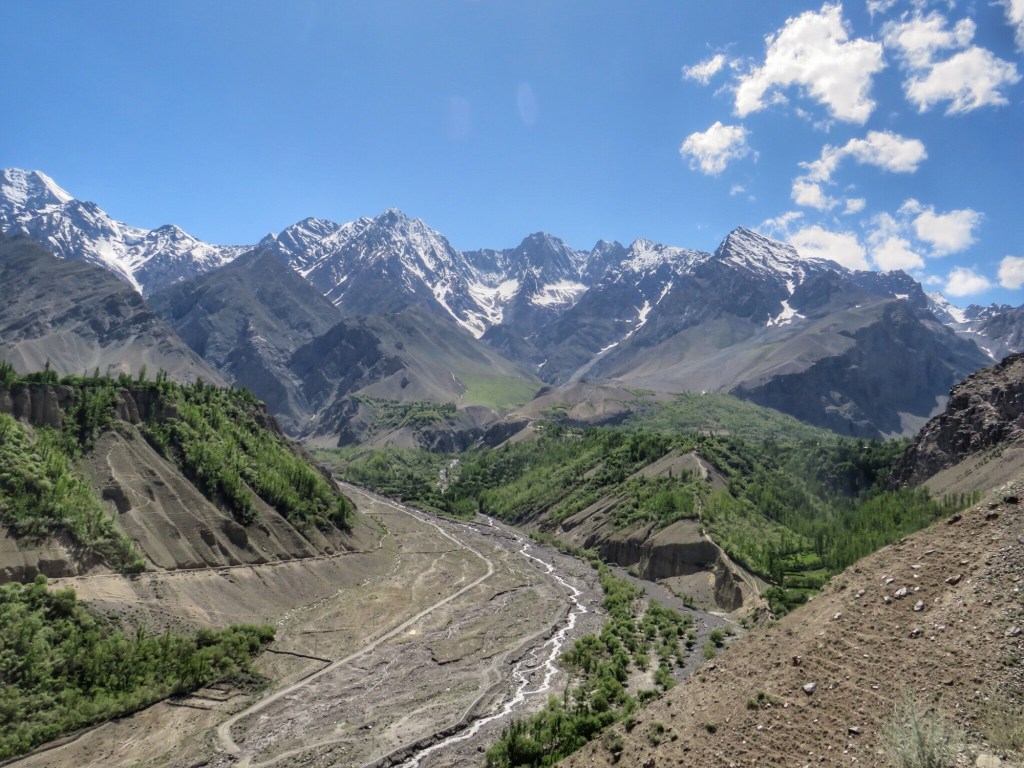
Flying into Skardu was pretty exciting, with a close-up, bird’s-eye view of some of the world’s highest mountains, including K2. The Karakoram and Himalayan mountain ranges meet here and the Indus River flows through on its way to Karachi. It seems the whole of northern Pakistan is made up of crazy rock formations, majestic soaring mountains, untamed rivers, culturally distinct valleys, and tiny green settlements perched on improbable ledges on the sides of inhospitable cliffs. For wild harsh beauty on a huge scale, northern Pakistan will knock your socks right off.

I think Pakistan is hands-down the friendliest country I’ve ever been to, and the Baltistan region is the friendliest place in the friendliest country. Western tourists are uncommon enough here that people’s faces visibly light up when they see you. Absolutely everybody – old people, children, teenagers, women, men – all smile and wave with real enthusiasm. Some shout “Hello!”. Imagine if people were welcomed like this everywhere, what a wonderful world it would be.

I needed to work for a few days in Skardu, so we booked a luxury apartment in the hope of having decent internet. Interpretations of ‘luxury’ can vary widely but in this case, it was justified. Everything was white, beige or gold and shiny, with six full-size couches and sparkly chandeliers in every room. It was like working inside a big frothy wedding cake.

One of the perks of this over-the-top apartment was having cheap access to a 4WD with a driver. Our driver, Sharif, didn’t speak much English but we could communicate just fine. He was very funny and loved to play loud Indian pop music while navigating dodgy roads on the edges of cliffs. Such fun! We went all over the place with him, exploring valleys, lakes, and even cold high-altitude deserts with sand dunes.
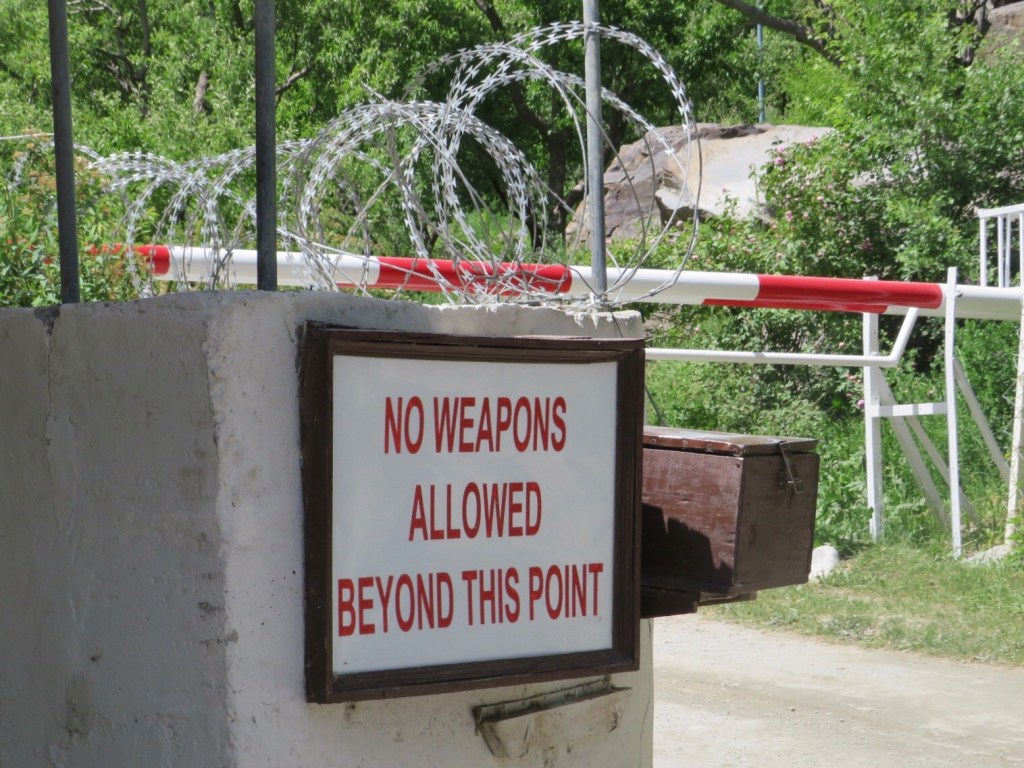
One of the most popular songs we heard playing all over the place in Pakistan is a song about Imran Khan. Imran Khan is the people’s hero. The common belief is that he’s locked up on trumped-up charges because he tried to go against the military, who are the real power in Pakistan. The military is very visible and you see a lot of guns.
The main thing in the Skardu area is the beautiful mountain scenery but equally fascinating are the small towns and villages tucked into the valleys and ledges. These are alive with people going about their daily business, working in the neat green fields, feeding goats and children, and washing clothes in the mountain streams that run between the adobe houses. I imagine it’s much the same as they’ve been doing for countless generations.

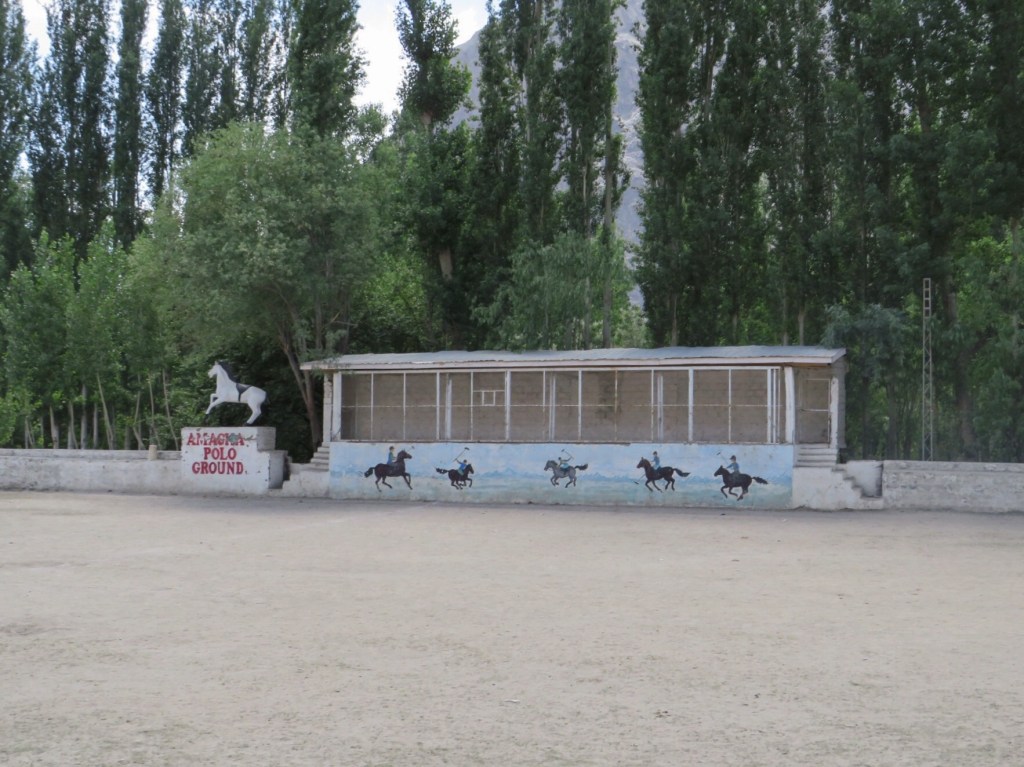
My favourite place in this region is the Shigar Valley. It has everything, old castles, forts and mosques, fruit orchards, interesting villages, and even bizarrely, a polo club.
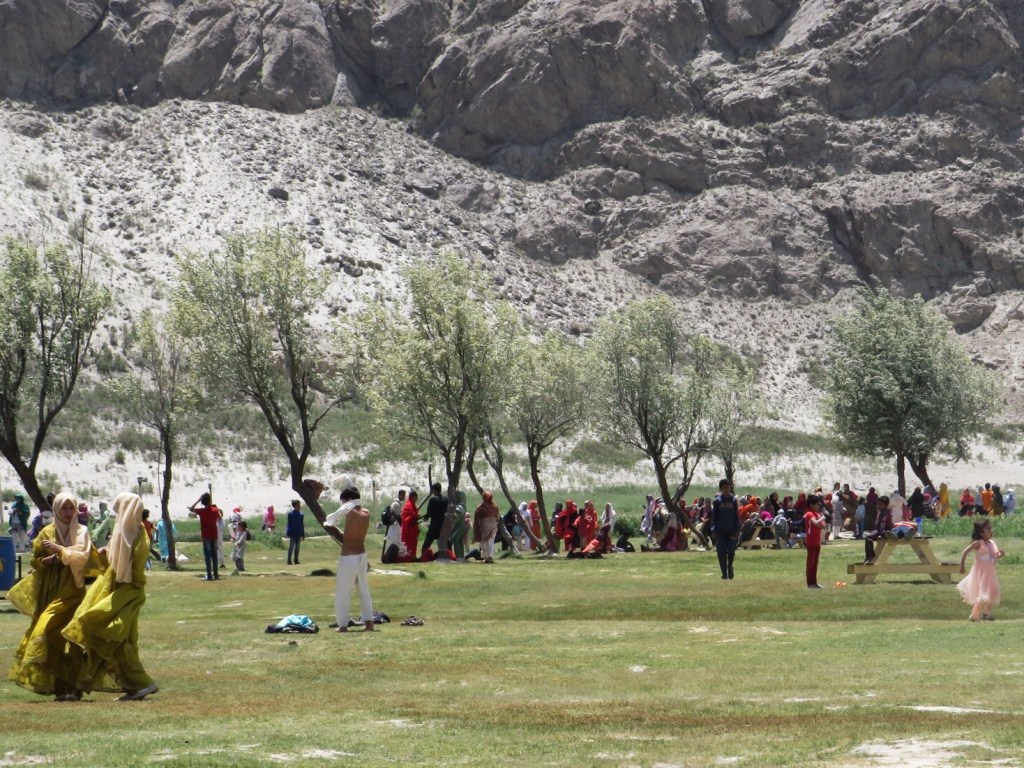
Here, we chanced upon a local holiday picnic at the lake. We were welcomed like visiting celebrities and everyone tried to feed us.


I wanted to go to Deosai National Park, the second-highest plateau in the world (Tibet has the highest). It’s a sanctuary for some pretty special endangered wildlife, including Himalayan Brown Bears and Snow Leopards. It can only be accessed for three months of the year and unfortunately, it wasn’t open yet. I convinced Sharif to drive us to the entrance anyway. When we got there, they let us in because we’d come all the way from Australia. I was so happy! We drove for a few hours until the road was blocked by an avalanche, and that was the end of that. We didn’t see any bears.

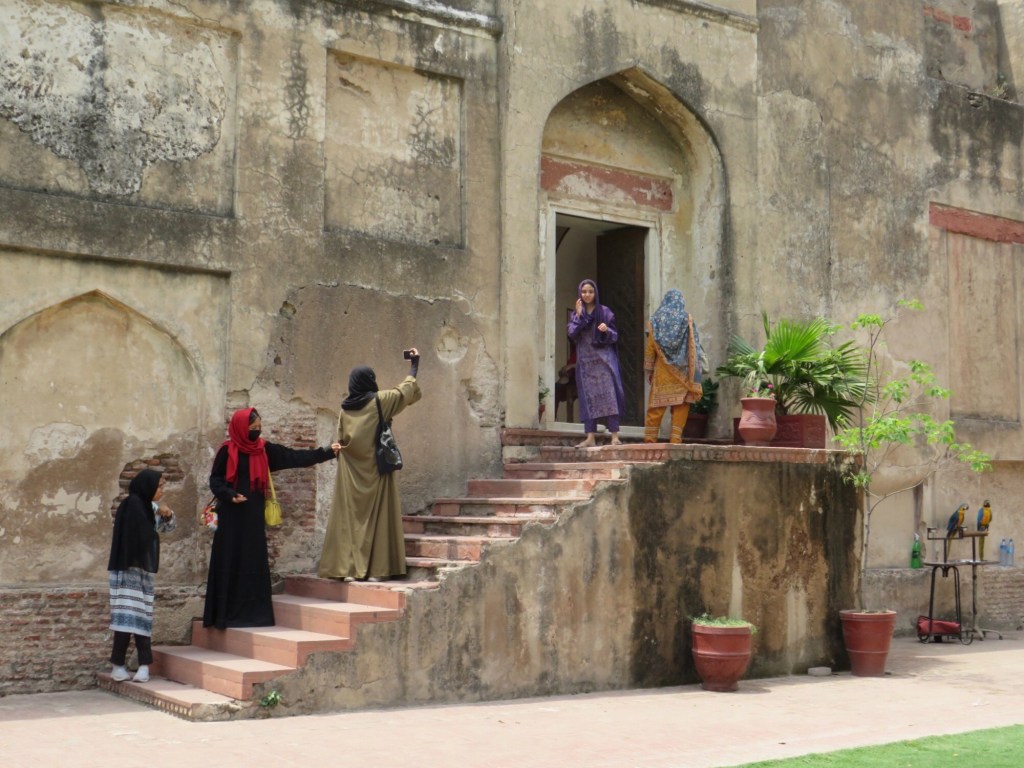
Pakistani women are very colourful and they wear Islamic clothing with style and flair. At one extreme you see some women covered head to toe in black and, occasionally, you see women with no head covering at all. Between these, there are infinite variations on the theme. I’ve never had the knack of wearing an elegantly flicked scarf, so I really struggled with it. I was constantly tripping over it, getting it tied up in knots, tangled around an ear, stuck under an arm, or falling in my eyes, so I couldn’t see where I was going. Random women would stop me and gently try to put me back together – straightening, wrapping, tucking, then nodding in satisfaction, “Now, you beautiful”. As soon as they turned away, I spontaneously unravelled.
The only way to get to the Hunza Valley from Skardu is by road. It‘s a full day’s drive on what used to be one of the world’s scariest and most dangerous high-altitude roads. Luckily for us, the road’s been fixed up, and with Sharif at the wheel it wasn’t scary at all. The scenery is simply breathtaking, with high mountains, sheer cliffs and glaciers that you can almost reach out and touch. Along the route you see remnants of the old Silk Road up on the mountains.


The Hunza Valley is very different to anywhere else. It’s the kind of place you could just stay, and stay, and possibly never leave. I felt like I could sit on the balcony of our room in the Hunza Lounge and watch the mountains forever.
The Hunza Valley was a mountain kingdom for at least 1000 years and a ‘princely state’ until 1974. The tiny capital was Baltit, now called Karimabad. This is where we stayed, and what a lovely little town it is. It’s a steep climb up the hill from our hotel to the shops and restaurants, but well worth the climb. Noushad, the owner of our small hotel, became a friend.
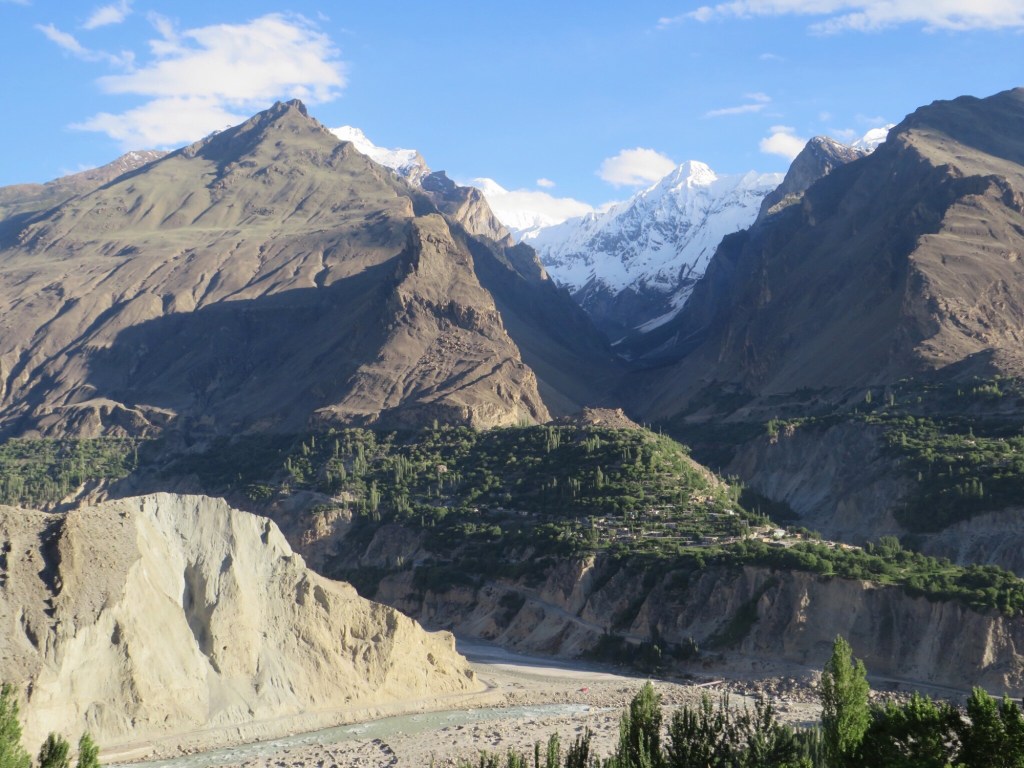
The Hunza is known as the ‘valley of the immortals’ due to its inhabitants’ longevity. It’s believed that people generally lived to be healthy into their old age, with an average lifespan of 120 years. Some reportedly lived to be over 140. This is usually explained as a combination of eating a healthy diet, drinking glacier water, having an active lifestyle, and being isolated from the outside world.
Before the arrival of Islam, the people were Buddhists or followers of the much older Bon religion. It’s much more liberal here. You can walk around without a head scarf, drink the Hunza fire water (local home-brewed alcohol) and smoke hashish from Peshawar (the hash capital of Pakistan, apparently). Compared to the fairly appalling literacy rates in Pakistan overall (69% for men and 46% for women), the Hunza Valley has a 95% literacy rate, and education is valued for both boys and girls. The three main languages spoken here are Burushaski, Wakhi and Shina, although education is either in Urdu or English.
Downhill from our hotel is the village of Ganish, the oldest Silk Road settlement in the Hunza Valley. Many of the old buildings, including watchtowers and mosques are intact. It’s very pretty and atmospheric and easy to imagine what it was like to live here in the past.

Noushad invited us to have dinner with his family in Ganish. His mother and sister-in-law cooked up a delicious feast of traditional food. It was fascinating to talk with his father, who has seen enormous changes in his lifetime. He said walking was the only transport when he was a boy. They walked everywhere, but it was still a kingdom then, and you needed permission from the king to go anywhere. He said the lifestyle changes from contact with the outside world has reduced their lifespan. Although life is easier now, it’s not as healthy. They exercise less and no longer eat only traditional food.
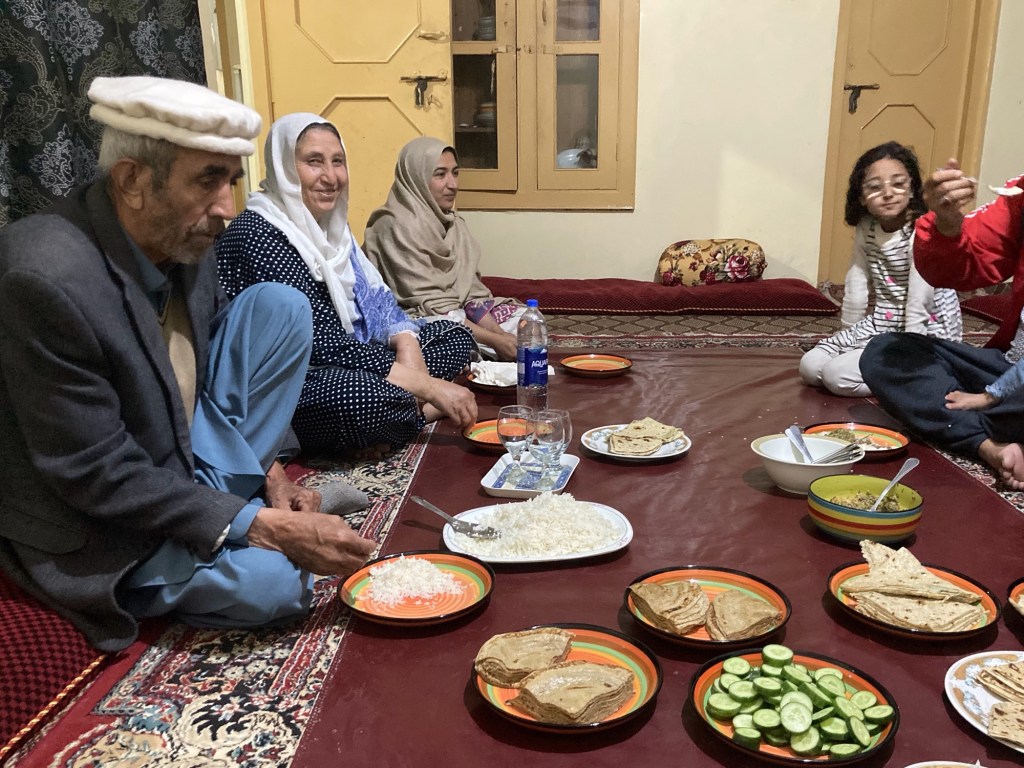
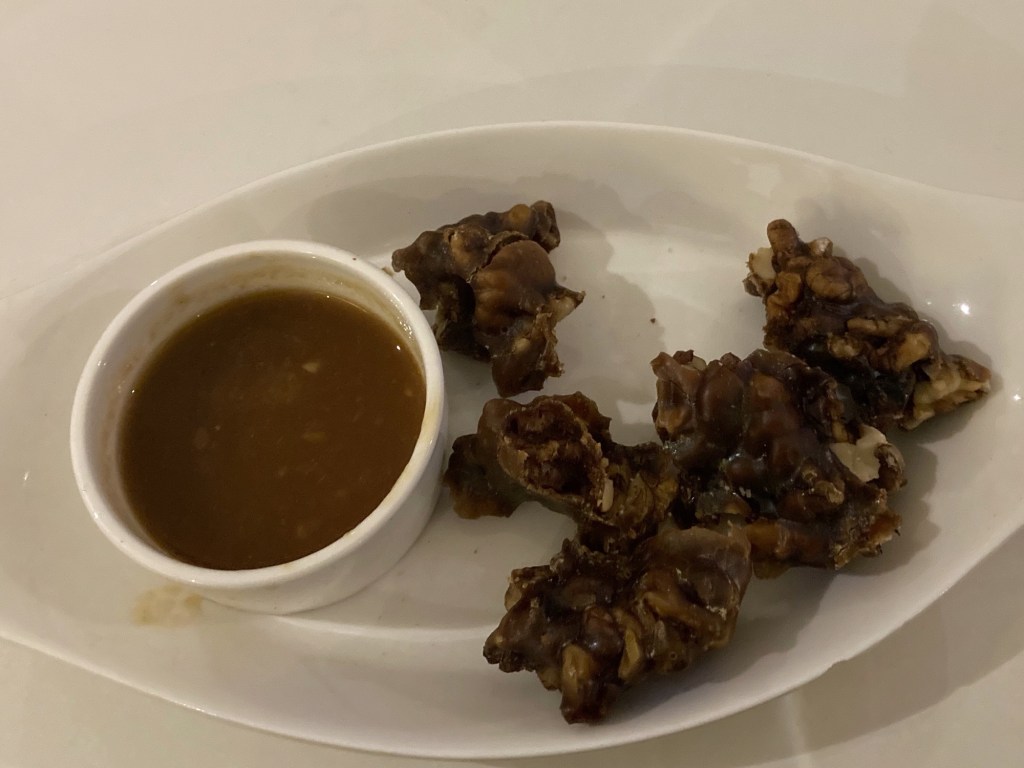
Until we got to the Hunza, our food choices were limited. In Pakistan, they put chicken in everything! We usually had only two options: Sabzi (mixed vegetables) or Dahl (lentils). If we were really lucky, we could get spinach, too. These are all eaten with flatbread and are invariably delicious, but not for every meal. My faith in Pakistani food was redeemed in Hunza, where the cuisine is unique and mostly plant-based. The main ingredients are apricots and walnuts.
The absolute highlight of Pakistan for me was when Noushad drove us north up the Karakoram Highway to the Chinese border. The Karakoram Highway (KKH) opened in 1978 and is also called the ‘China-Pakistan Friendship Highway’ for obvious reasons. Due to its extreme altitude and treacherous terrain, it’s sometimes called the ‘eighth wonder of the world’. Over 1,000 workers died in its construction. I got to drive for a while, so I’ve driven on the Karakoram Highway! Woot!
On the way we stopped at Attabad Lake. This beautiful lake was formed from a disaster in 2010 when an avalanche blocked the Hunza River and wiped out the nearby villages.

Along the road, we saw the incredible Batura and Passu Glaciers and Tupopdan (the Passu Cones or ‘Cathedral’). The Passu Cones are a series of pointy mountain tops that really do look like a massive cathedral.

We stopped for a cuppa at the frontier town of Sost, the last settlement before China. On the way up, it was quiet and sleepy, but on the way back, it was a hive of activity. A load of transport vehicles had arrived from China carrying goods for sale, including smuggled contraband, like small bottles of alcohol, and everyone was engaged in trade.
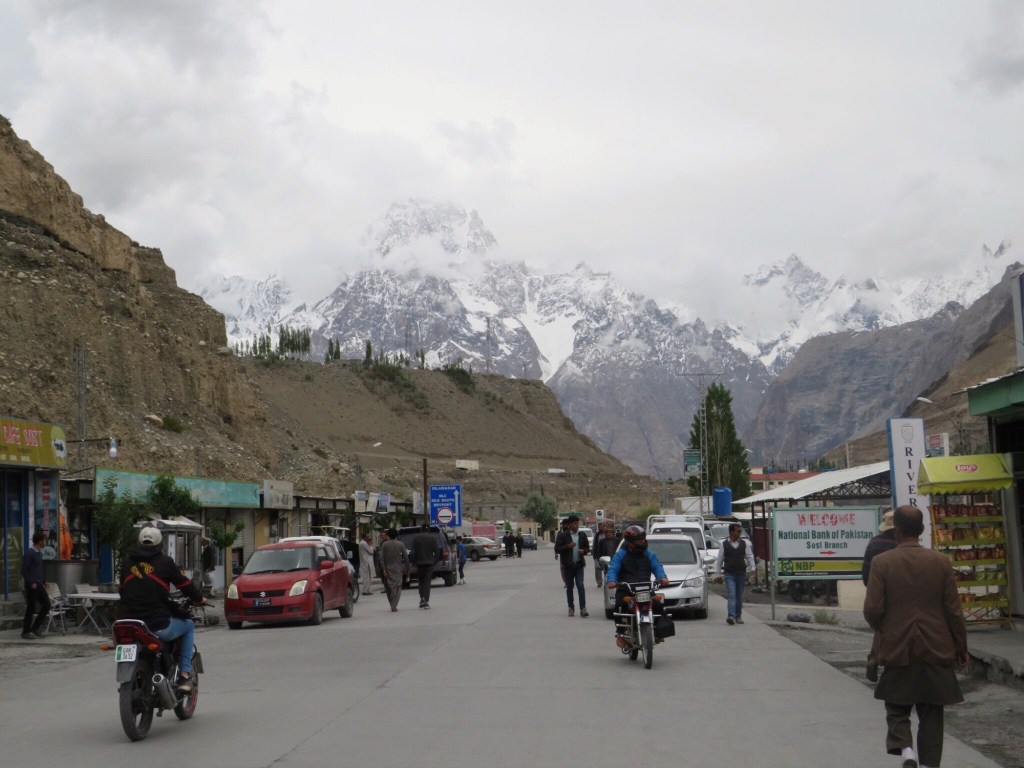

After Sost, we entered the Khunjerab National Park. This park is a sanctuary for several critically endangered species, including Marco Polo sheep, snow leopards, Indian wolves, and Himalayan brown bears. We didn’t see any of those, but we did see some Himalayan ibex, woolly yaks, and marmots. I don’t think I’ve ever seen a marmot before. I love them.

At last, we reached the Khunjerab Pass, the highest border crossing in the world at 4,693 metres. The scenery is fantastic up here on top of the world, but the air is thin and hard to breathe.

On the other side of the border is Xinjiang, home of the Uyghur people. It’s not far from here to Kashgar, from where we set out to cross the Irkeshtam Pass to Kyrgyzstan just a few years ago.

Before we started the trip back down the mountains, I needed to go to the toilet. The only toilet block was way across the ice, which seemed like a million miles at this altitude. I struggled my way across the ice like a hardcore mountaineer, but when I got there, I realised I hadn’t seen the big sign that said you had to pay. I hadn’t taken any money with me. Aagh! The trials and tribulations.

We booked a flight back to Islamabad from Gilgit, the big town just south of the Hunza Valley. I had heard that these flights get cancelled a lot, but the weather was good, and, ever the optimist, I figured it’d be fine. Not so. It seems the airline just cancels them for no reason at all. Damn. That meant a nightmare 20-ish hour bus ride to Islamabad or going back to Skardu and flying from there. Noushad’s lovely brother Mushtaq (affectionately known as ‘Mooshy’) drove us all the way back to Skardu.

I admit I was a bit nervous about going to Pakistan, in case the Taliban were hiding under the bed, but I felt completely safe the whole time. Locals say that everywhere is safe to go now (except Balochistan). There is so much more to discover in beautiful Pakistan and I really hope to come back.


Pakistan sounds amazing! The people and the scenery so beautiful. I am sure you will be getting more skilled day by day wearing a scarf Jeanne! And love your story about the toilet block 😆
LikeLike
Haha. Northern Pakistan is amazing Liz x
LikeLike
Once again Jeanne a great insight into your journey loving the pictures from Hawk as well stay safe and enjoy 😉 😀
Darkie
LikeLike
Thanks Darkie!
LikeLike
Another awesome chapter of your travels. I love reading them and the pictures are fantastic. keep them coming.
LikeLike
Thanks Murf x
LikeLike
Love hearing about Pakistan Jeannie. My brother speaks of the warmth and generosity of the people from his travels. The way you write feels a like I experience a little of the wonder of your travels. Thanks for sharing this. xx
LikeLiked by 1 person
Thanks Anne x I’m so glad you’re coming along with me on my travels 🙂
LikeLike
Hello you beautiful couple,
Thank you so much for sharing your amazing experiences!!!
Stay safe, keep travelling and writing !!!
Lots of love
Kismet xxx
LikeLiked by 1 person
Thank you Kismet xxx I’ve been thinking about you lately! We were looking at going to Kurdistan but we’re not going to have enough time right now 🙁. One day!
LikeLike
Hiya JS awesome to read of some of your adventures!! My fb got hacked so I’m not going to bother with it any more..so bloody great to get your emails xoxo
Yahoo Mail: Search, organise, conquer
LikeLiked by 1 person
Yay! It’s great to hear from you Wendy xxx I was wondering about the best way to contact you. Maybe WhatsApp?
LikeLike
Yes whatsapp for sure xx
Yahoo Mail: Search, organise, conquer
LikeLiked by 1 person
Aw
<
div>A really lovely read. Mountains & beautiful peop
LikeLiked by 1 person
Thanks Alex x
LikeLike
Thanks Jeanne. So informative, l learnt so much. Keep them coming and have fun. Pete
LikeLike
Thanks Jeanne. So informative, l learnt so much. Keep them coming and have fun. Pete
LikeLiked by 1 person
Learnt so much about Pakistan Jeanne. Thanks. Have fun 👍
LikeLiked by 1 person
Thanks Pete x Me too 🙂
LikeLike
Wow. Wow. Wow. These are some epic travel tales! I’d love to see a pic of you in your inelegantly flicked scarf 🙂
LikeLiked by 1 person
Hahaha I’m not sure if I’ve got one. I was too busy trying to hold it together 😂
LikeLike